Customer Intelligence & Retention
Marketing Intelligence · March 2, 2026 · 12 min read
Generic AI platforms produce plausible-sounding marketing strategies from five-line prompts. inMOLA is built differently — twenty-five years of operator experience encoded into algorithms, with AI as the accelerator, not the strategist.
There is a video format flooding LinkedIn right now. Someone opens ChatGPT, types five lines about their business, and asks the model to "build a brand strategy." Ninety seconds later, they paste the output into a slide and call it a strategy. The comments are full of applause. The numbers, six months later, are not.
This is the central confusion of the current AI-in-marketing moment. Generic AI platforms are extraordinary general-purpose tools, but marketing is not a general-purpose problem. It is a discipline with twenty-five years of accumulated craft, hundreds of interacting variables, and consequences measured in millions of dollars of misallocated budget. Treating it as a prompt-and-pray exercise is not modernization. It is expensive amateurism dressed up as innovation.
inMOLA was built on a different premise. It is not a thin wrapper around a foundation model. It is the codified output of Erkan Terzi's twenty-five years operating inside corporate marketing teams and advising dozens of companies — frameworks, scoring systems, and algorithms that were first built in Excel, refined across real campaigns, and only then handed to AI as a tool for acceleration. The AI inside inMOLA is not the strategist. It is the executor of a strategy that already knows what good looks like.
This piece is about that difference, and why it matters for any company spending serious money on marketing.
Generic AI platforms produce output that matches the depth of input they receive. This sounds obvious until you watch what people actually type into them. A founder pastes a one-paragraph company description and asks for a positioning strategy. A marketing manager describes three competitors in two sentences and asks for a competitive analysis. A CMO types last quarter's revenue and asks where to cut spend.
The output looks confident. It uses the right vocabulary. It produces frameworks with neat headings. And it is almost entirely useless, because marketing decisions are not made on five lines of input. They are made on the interaction between brand equity, channel performance, competitive movement, audience behavior, pricing position, share of voice, sales pipeline data, retention curves, and roughly thirty other variables that no one is going to type into a chat window.
When the input is shallow, the output is plausible-sounding generic advice. When that advice gets implemented at scale, it produces two predictable outcomes: budget waste in the millions, and the slow erosion of brand equity that no one notices until it is too expensive to rebuild.
inMOLA inverts this. The platform operates across forty-plus integrated modules covering CRM data, brand valuation, AI visibility tracking, SEO performance, paid media efficiency, reputation monitoring, social signal analysis, and PR media valuation. Every module pulls from the company's own data, layered with public data and competitor data, so the AI is never working from a five-line summary. It is working from a full picture of the business — the kind of picture a senior CMO would spend six months assembling by hand.
The most important architectural decision in inMOLA is that the AI does not generate strategy. The algorithms do. The AI helps deliver, synthesize, and accelerate.
This matters more than it sounds. When you ask a generic AI platform "what should our brand strategy be," the model is generating an answer from its training data — essentially a remix of every marketing blog post and textbook it has ever seen. The answer is plausible. It is also untethered from your category dynamics, your competitive position, your historical performance, and the specific failure modes of your industry.
Inside inMOLA, the strategic logic is encoded before the AI is involved. The scoring systems, the weighting of variables, the diagnostic questions, the decision trees — these come from Erkan Terzi's twenty-five years of running marketing inside corporates and advising others. The AI's job is to take that codified expertise and apply it at speed and scale. The work that used to take months of senior consulting time now takes hours. But the strategic backbone is human, tested, and proprietary.
This is the difference between using AI as a strategist and using AI as a power tool in the hands of one. The first produces confident-sounding answers nobody should trust. The second produces output that carries the weight of real operating experience.
The marketing AI demos circulating on social media share a common feature: they promise results in minutes. Type a prompt, get a strategy. Type a brief, get a campaign. Type a question, get an answer.
This is the wrong shape for marketing decisions. Real marketing intelligence is longitudinal. Brand equity moves slowly. Share of voice shifts over quarters. Reputation builds and erodes across years. Paid media efficiency reveals itself only after enough data has accumulated to separate signal from noise. Any system that promises a one-hour strategy is, by definition, ignoring the variables that actually determine success.
inMOLA is built around continuous evaluation. The scoring systems run in permanent improvement mode. Data is collected, tracked, and analyzed across months, not minutes. Decisions are revisited as conditions change. A campaign that scored well in month one might be flagged for reassessment in month four because competitive dynamics shifted. This is what real marketing intelligence looks like — not a fast answer, but the right answer maintained over time.
The trade-off is honesty. inMOLA does not promise instant transformation. It promises rigor, continuity, and the kind of compounding strategic advantage that only comes from sustained observation. That is a harder thing to sell in a demo video. It is also the only thing that actually works.
There is a quieter issue with generic AI use in marketing that most companies have not yet thought through carefully. When a marketing team pastes customer data, competitive intelligence, pricing models, or strategic plans into a consumer AI chat window, that data is now sitting in a context most companies cannot fully audit. The legal teams are starting to notice. The security teams have been worried for a while.
inMOLA was built as enterprise infrastructure from day one. Data is encrypted in transit with TLS 1.3 and at rest. Role-based access control governs who sees what. Customer data is isolated between tenants. There is continuous traffic monitoring, automated abuse detection, audit logging across critical actions, and a defined incident response process. The platform operates under GDPR compliance with documented policies for privacy, terms, and data handling.
This is not a marketing claim. It is the baseline expectation for any SaaS platform that handles strategic business data, and it is the baseline that consumer AI tools do not meet — not because they are badly built, but because they are not designed for that use case. Using a consumer chat interface for enterprise marketing decisions is a category mistake.
Set aside the marketing language for a moment and consider what a CMO is actually choosing between.
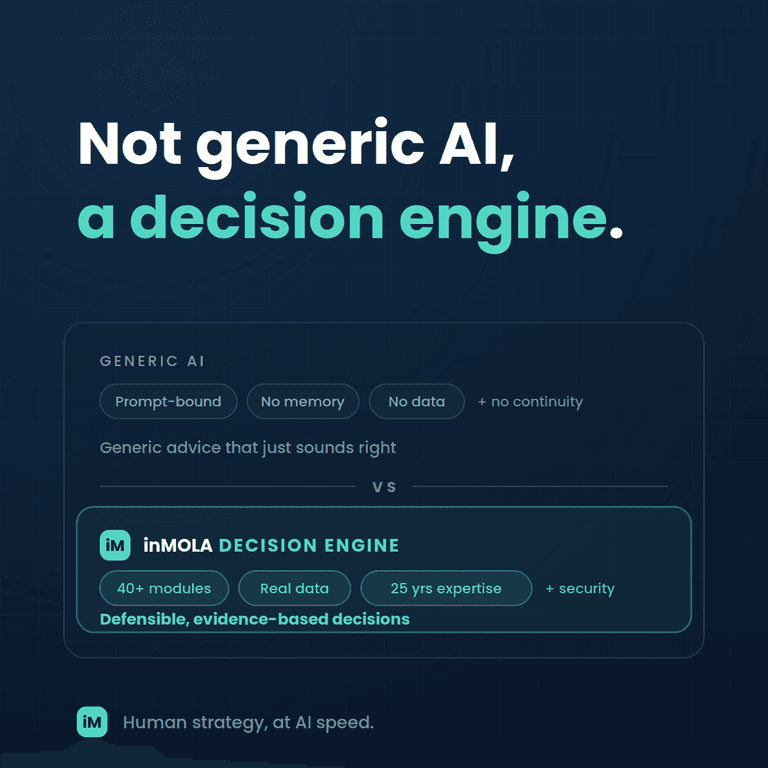
On one side: a general-purpose AI platform that produces fluent answers based on whatever the user types into a prompt. It has no memory of the business, no integration with the company's data, no encoded marketing expertise, and no continuity of observation. It will give a confident answer to almost any question. It will not give the right one to any question that matters.
On the other side: a decision engine built on proprietary algorithms developed by an operator who spent twenty-five years inside the discipline. It integrates the company's own data with public and competitive intelligence across forty-plus modules. It runs continuously, scoring and rescoring as conditions change. It is designed for enterprise security and data handling. The AI inside it is an accelerator for human strategic logic, not a replacement for it.
The first is a productivity tool that anyone can use to produce mediocre marketing thinking faster. The second is strategic infrastructure that produces decisions a senior marketing team can actually defend to a board.
The companies that confuse these two will spend the next three years discovering, expensively, that they were not the same thing.
The question is not whether to use AI in marketing. That question is already settled. The question is what kind of AI, built by whom, with what encoded expertise, on what data, with what security posture, and over what time horizon.
The answer that most companies will arrive at — after enough wasted budget — is the one inMOLA was built to provide from the start. Generic AI is a useful general tool. Marketing decisions are a specific, high-stakes, longitudinal problem. The two do not match. The companies that figure this out early will build a compounding strategic advantage over the ones still typing five-line prompts into chat windows and calling the output a strategy.
inMOLA is what marketing intelligence looks like when it is built by someone who has actually done the work.
Customer Intelligence & Retention
Customer Intelligence & Retention
Customer Intelligence & Retention