Customer Intelligence & Retention
Brand Reputation Monitoring · June 19, 2026 · 11 min read
For twenty years brand monitoring has been dominated by a single instrument — the mention count. Volume up is good. Volume down is bad. Sentiment attached is the modifier. That model built a reporting industry, but it stopped answering the questions enterprises actually needed answered years ago. The specific problem is that two brands with identical mention volumes and identical sentiment distributions can be facing completely different reputation situations, and the mention-count report cannot tell them apart. Here is why theme analysis has become the primary layer of modern brand monitoring, what it actually reveals that volume misses, and how enterprises are rebuilding their monitoring to read the conversation instead of counting it.
For twenty years brand reputation monitoring has been dominated by a single instrument. The mention count. Volume up is good. Volume down is bad. Sentiment attached as a modifier — positive, negative, neutral proportions applied to the volume — refined the reading but did not change the fundamental measurement. Enterprise brand monitoring reports have been built around the mention count for so long that the industry has forgotten it is a choice rather than a necessity.
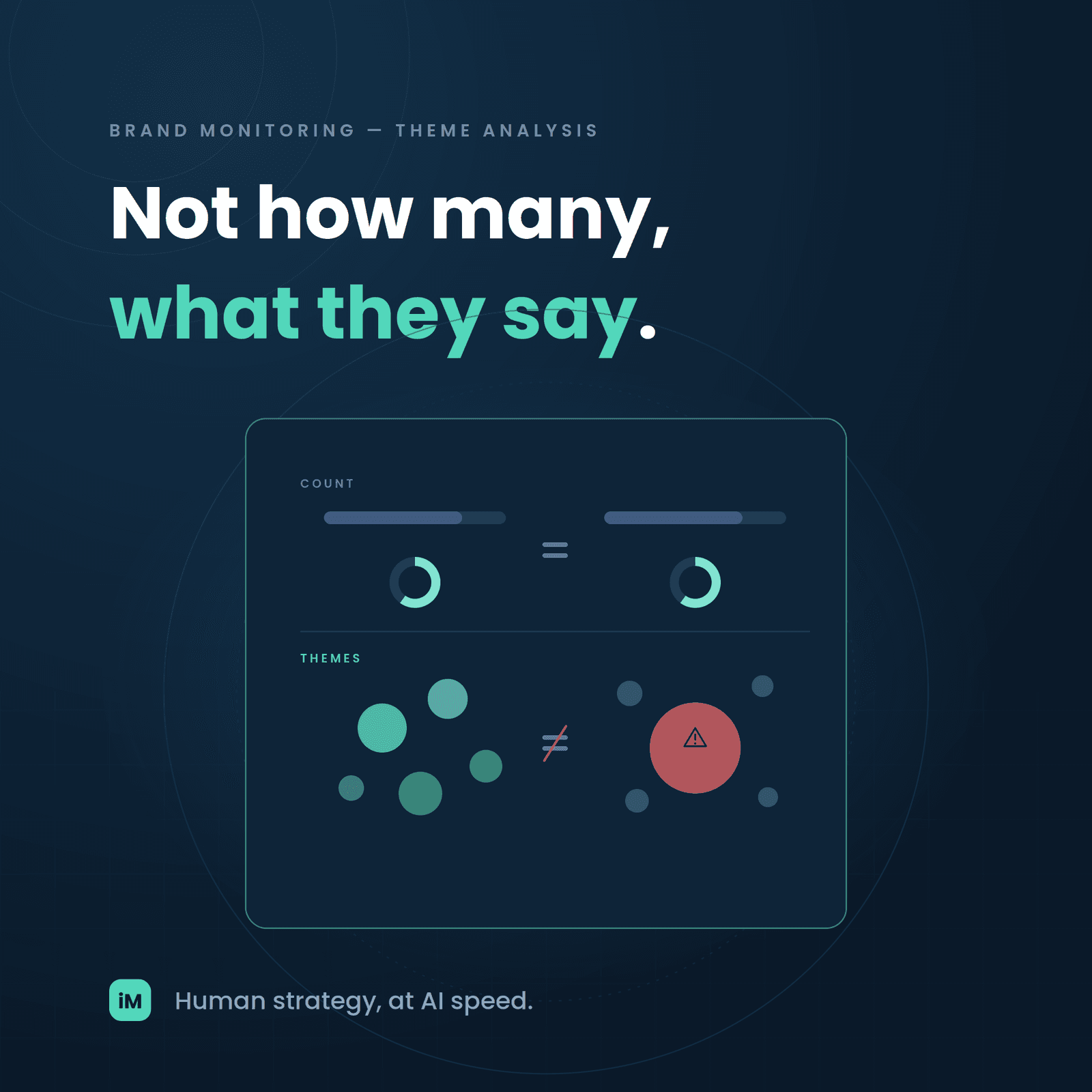
The mention count is a useful measurement. It captures whether the brand is more or less part of the conversation than it was. It captures whether attention is growing or shrinking. It captures the raw scale of what is being said. What it does not capture is the specific content of what is being said, and in 2026 the content is where the reputation signal actually lives. Two brands with identical mention volumes and identical sentiment distributions can be facing completely different reputation situations, and the mention-count report cannot tell them apart. One brand is dealing with a product-quality conversation. The other is dealing with a founder-controversy conversation. The volume and sentiment look the same. The strategic response is completely different. And the difference is invisible without theme analysis.
Theme analysis — the specific practice of classifying every mention by the topic it is about, and reading the theme distribution as the primary reputation signal — has become the operating layer of modern brand monitoring. This piece walks through why volume-first monitoring stopped answering the questions enterprises actually need answered, what theme analysis reveals that volume alone misses, and how enterprises are rebuilding their monitoring to read the conversation instead of counting it.
The volume-first model was built when the industry was solving a specific problem: given the flood of social media mentions, how does a brand know whether attention is growing or shrinking. Mention count answered that question, and it was a real question in the era when digital brand monitoring first became widely practiced.
Three developments have made the volume-first answer progressively less useful over the past decade.
Brand mention volume responds to many stimuli that have little to do with reputation. A single algorithmic bump on a platform can drive volume up 40% for a week. A viral moment on a competitor's post can drag mentions of the target brand along with it. A category-level news cycle can inflate every brand in the category. A seasonal effect can predictably drop mentions in a way that has no reputation content at all. Volume-first monitoring reports these as if they were reputation signals, and enterprise teams spend time explaining fluctuations that have no strategic meaning.
Sentiment attached to volume — the percentage of mentions that are positive, negative, or neutral — is a real refinement but still averages out the actionable signal. A brand whose sentiment distribution is 60% positive, 30% neutral, 10% negative reads well in the report. That distribution can co-occur with either of two very different underlying situations. In one, the negative mentions are distributed across many unrelated complaints and none of them individually matters. In the other, all 10% of negative mentions are about the same specific issue and they represent an emerging pattern that will consolidate into a crisis if the enterprise does not address the specific issue. The sentiment average cannot distinguish these. The theme distribution can.
The most important shift is in what enterprises actually need reputation monitoring for. In an earlier era the primary question was surveillance — is the brand being talked about, positively or negatively. That question is still asked, but it is no longer the primary strategic question. The primary strategic question is diagnostic — what specifically is driving the reputation signal, and what should the brand do about the specific driver. Diagnostic questions require theme decomposition of the conversation. Volume can be a summary variable. It cannot be the answer to a diagnostic question.
Theme analysis decomposes the mention stream by topic. Instead of a single volume number and a single sentiment distribution, the enterprise sees the mention stream broken into the specific themes the audience is actually discussing, with volume and sentiment attached to each theme. The primary output is not a number but a distribution — the specific themes ranked by their share of the conversation, each with its own sentiment profile.
The distribution reveals things that volume and sentiment averaging cannot.
The largest share of most brand mention streams is neutral in sentiment. Neutral is often treated as uninteresting in volume-first monitoring — no negative signal, so no need to investigate. Theme analysis reveals that neutral often decomposes into specific patterns that are strategically meaningful. Product-question mentions. Comparison mentions where the brand is being weighed against competitors. Category-adjacent mentions where the brand is being referenced in a discussion that is not about it directly. Each of these has a different strategic implication, and each is invisible in a volume-first report that treats them as one indistinguishable neutral bloc.
When negative sentiment rises, volume-first monitoring shows the enterprise that negativity is rising. Theme analysis shows what the negativity is about. A rising share of negative mentions that decompose into product-quality complaints is a different strategic situation from a rising share that decomposes into customer-service complaints, and both are different from a rising share that decomposes into founder-controversy or brand-safety mentions. The response path is theme-specific. The volume-first report cannot direct the response to the specific theme because the theme is invisible in the report.
The most consequential shift is that theme analysis lets the enterprise read the shape of the conversation rather than just its size. A brand whose theme distribution has ten fairly equal themes is in a different position from a brand whose theme distribution has one dominant theme accounting for 70% of the conversation. The concentrated pattern is either a crisis (if the concentrated theme is negative) or a moment of category ownership (if the concentrated theme is positive). Either way, the pattern is diagnostic, and it is invisible in a volume metric.
Enterprises that shift from volume-first to theme-first monitoring rebuild the shape of their reporting. The rebuild has specific characteristics that separate theme-led reports from the volume-led reports they replace.
This is a different report from the volume-led report enterprises used to produce. The executive audience learns to read the theme distribution as the primary signal within a quarter or two of the shift. Once the muscle is built, the volume-led report starts to look thin — it captures scale but does not answer the strategic questions the audience has learned to ask.
Theme analysis is a substantial improvement, but it does not solve every reputation monitoring problem. Naming the residual challenges keeps the shift honest.
Theme analysis does not solve detection speed. Themes still need to be surfaced within the crisis window, and if the classification runs on a monthly cadence rather than continuously, the theme insight arrives too late to shape the response. Continuous theme classification is the specific requirement — themes surfaced as mentions accumulate rather than aggregated at month-end.
Theme analysis does not solve attribution. Knowing that a specific theme is driving negative share tells the enterprise what to respond to, but it does not tell the enterprise what specifically caused the theme to emerge. A rising customer-service complaint theme could be caused by an actual service degradation, by a competitor amplifying an anecdote, or by an emerging community pattern that has nothing to do with the enterprise's own actions. Attribution requires investigation on top of theme detection.
Theme analysis does not eliminate the value of volume metrics entirely. Volume still matters for understanding scale, for tracking trend across quarters, and for connecting reputation monitoring to executive metrics that are quoted in the language of aggregate numbers. The point is not to eliminate volume from the report but to demote it from primary metric to context variable, and to elevate theme distribution to the primary metric it should have been for the past decade.
For twenty years brand monitoring answered the question of how much the brand was being talked about. In 2026 the question that actually matters is what specifically is being said, and about which theme. The enterprises that have made this shift are reading the shape of the conversation. The enterprises still counting mentions are measuring the size of a signal whose content they cannot see.
inMOLA's Brand Sentinel module runs continuous theme classification on every mention alongside the sentiment scoring. Themes are surfaced as the mentions accumulate rather than being computed at report time, so the enterprise sees the theme distribution shift in near-real-time rather than in the monthly summary. When a specific theme concentrates or when a new theme emerges, the shift is visible in the dashboard within hours of the pattern developing.
The theme distribution pairs with the sentiment layer so the enterprise can see not just what themes are dominant but which themes are driving positive share and which are driving negative share. When a theme with rising negative share is detected, the alert pairs with the specific theme context, so the response can be directed at the theme rather than at aggregate negativity. This is what turns the monitoring stack from a surveillance instrument into a diagnostic instrument.
The strategic value of the shift is not that the reports look nicer. The value is that reputation monitoring stops being a size measurement and starts being a content measurement, and the response paths that flow from the monitoring become theme-specific rather than generic. In 2026 the enterprises operating with theme-led monitoring are catching the specific reputation risks their volume-led competitors are still averaging into invisibility. The compounding across reputation events is where the strategic difference shows up. Each avoided or well-managed event that theme analysis surfaced quickly compounds against each averaged-away event that volume-first monitoring surfaced too late.
Customer Intelligence & Retention
Customer Intelligence & Retention
Customer Intelligence & Retention