Customer Intelligence & Retention
Real-Time Web Personalization · July 10, 2026 · 8 min read
The generic homepage optimized for the imagined average visitor is optimized for a person who does not exist. The composition of your bounce rate hides five audiences the current hero is silently losing.
Every marketing team's website starts with the same assumption. Build one homepage, get the message right, run it against everyone. If the conversion rate is not what the finance team hoped for, iterate on the hero — change the headline, swap the image, test a new call to action. Six months later the conversion rate has moved half a percentage point, and the marketing team has spent forty hours in review meetings that felt like debating shades of gray.
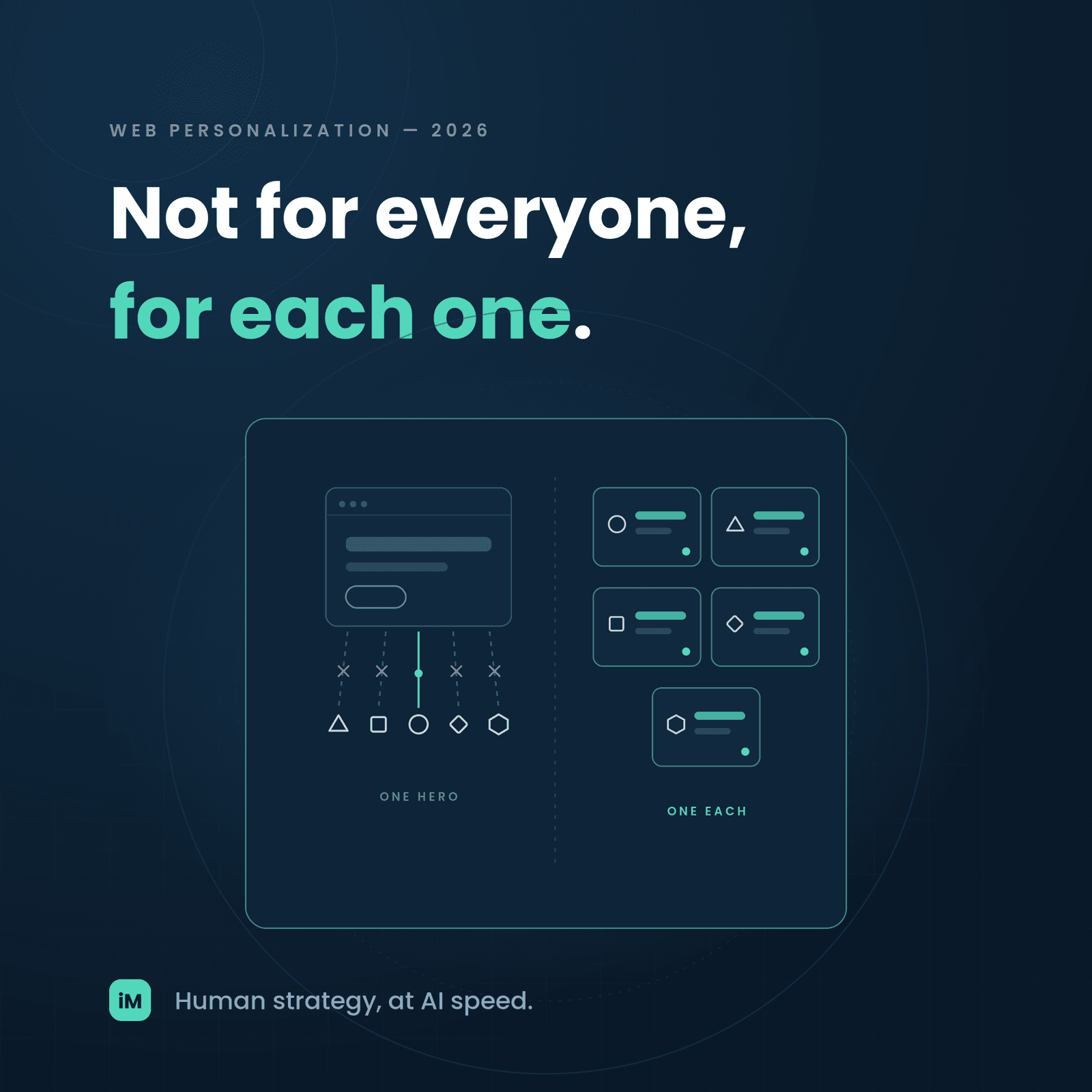
The reason the number will not move much further is that the homepage is not underperforming for one reason. It is underperforming for many reasons at once, and the single-hero framing hides all of them. The visitor from Istanbul who bounces on a US-centric hero is a different failure than the returning shopper who abandoned a large appliance and is greeted by a shoe campaign. The mobile visitor served a desktop-heavy slider that takes eight seconds to load is a third failure. The person who clicked a Meta ad about a specific product and lands on a homepage that mentions everything except that product is a fourth.
The imagined 'average visitor' the homepage was built for does not actually exist. What exists is a distribution of visitors, each with their own context, each responding to the hero as though it were designed for someone else. This piece walks through the specific cost of the one-size hero, why the standard A/B testing loop cannot close it, and what changes when the hero adapts to the visitor's context in real time.
The visible cost of the generic homepage is the bounce rate. A homepage bouncing at 55% is not producing 45% conversions — it is producing something much smaller after the visitors who did not bounce navigate through the funnel. But even the bounce number is misleading. The 55% bouncing is not a random 55%. It is disproportionately the visitors whose context was mismatched to what the hero was serving.
The invisible cost is the compounded downstream loss. The visitor who bounces on the wrong hero does not come back three times to check. They form an impression of the brand — 'not for me, not what I was looking for' — and the next paid ad they see for that same brand costs more to convert them a second time. The one-time bounce becomes a permanent friction that the acquisition team spends the rest of the quarter trying to rebuild against.
The magnitude is easy to underestimate because most analytics tools report bounce rate as an aggregate. Segmented bounce rate — by traffic source, by geography, by device, by referring campaign — usually reveals two to three times the variance the aggregate hides. A homepage bouncing at 55% overall often bounces at 30% for its best-matched segment and 75% for its worst-matched. The 45% gap is the specific cost of not serving each segment the hero it needed.
The mental model that produces one-hero homepages is the same one that produces average-customer marketing. It assumes the middle of the distribution is representative — that if the hero speaks to the typical visitor, most of the audience is served. In practice the middle of the distribution is often the smallest population. The audience is bimodal, or trimodal, or a mixture of five or six overlapping segments, and the middle-of-the-distribution message speaks well to none of them.
The specific pattern is easy to see once you look for it. A homepage designed for 'the shopper researching a purchase' fails the shopper who already knows what they want. A homepage designed for 'the buyer comparing options' fails the returning customer who is not comparing anything. A homepage designed for 'the first-time visitor' fails the visitor who has been there three times and is annoyed by the repeated introduction. Every design choice that serves one segment more directly serves the others less.
The one-hero constraint forces the design conversation into a false trade-off. Someone always has to lose. The team optimizing the homepage picks which segment gets served best and accepts the cost on the others, usually without measuring what that cost actually is. Reflex-style personalization removes the trade-off by removing the constraint — the hero does not have to be the same for every visitor because it does not have to load the same for every visitor.
The reason marketing teams keep optimizing the hero without moving the number is that they are optimizing against the average of a mixture, and the average of a mixture is not what any single segment needs. Improving the hero for one segment usually degrades it for another, and the two effects roughly cancel out in the aggregate. The graph does not move because the segments moved in opposite directions.
The composition of a typical bounce number breaks down along four axes: where the visitor came from geographically, how they arrived (source, campaign, referrer), what device they are on, and what they have done on the site before. Each axis produces multiple segments, and the segments interact. The visitor from Istanbul on a mobile phone who came from a Meta ad about washers who was on the site last week is a specific combination that the aggregate bounce rate cannot address.
The moment the marketing team can see the segmented distribution — bounce rate by combination rather than by average — the decision to swap the hero per segment stops being a preference and becomes obvious. The 30% bounce on the best-matched segment is the ceiling. Every other segment is a candidate for a matched hero that pulls them closer to the 30%. The gap is the addressable revenue.
Every marketing team's homepage has the same short list of audiences it was actually designed for and a longer list of audiences it was not. The audiences on the second list are usually the specific ones with the highest revenue impact if served correctly.
The addressable revenue in this list is not evenly distributed. In most enterprise programs, the abandoned-shopper segment and the paid-ad segment together account for more than half the compounded conversion opportunity. But the mobile and regional segments compound quietly over the quarter, and the weather segment periodically produces short high-value windows the generic homepage misses entirely.
The first change is visible in the bounce composition. The best-matched segment stays where it was, and the previously worst-matched segments begin to converge toward it. The aggregate bounce rate does not always move dramatically in the first month, but the variance across segments narrows, and the total conversions produced rises even when the visible headline metrics look similar.
The second change is qualitative. The marketing review conversation stops being about 'which hero to run next' and starts being about 'which segments still do not have a matched hero.' The design bottleneck moves from choosing a single winning creative to producing several segment-specific creatives, which is a much more solvable problem because the criterion for each is clearer.
The third change is at the operating rhythm. The engineering backlog stops being the bottleneck because the rules are set in a panel, not in a pull request. A marketer can watch the bounce composition on Monday, identify a segment that needs a matched hero on Tuesday, publish the rule on Wednesday, and read the impact on Thursday. The four-day loop replaces the four-week loop, and the compounding across a quarter is substantial.
The homepage that talks to everyone is optimized for a person who does not exist. Every segment is a chance to talk to someone who does.
Moving off the one-size hero does not require rebuilding the site. It requires deciding that the hero will adapt to the visitor's context, then setting the first few rules — abandoned shopper, matched-ad landing, regional adaptation, mobile-optimized variant, weather-sensitive swap — and watching the segmented bounce rate close over the next four to six weeks.
inMOLA's Reflex module reads the visitor's context the moment they land — country, city, weather, day and hour, referring source, device, and prior browsing history — and swaps the hero, banners, and calls to action according to rules a marketer builds in minutes. The swap happens without a page reload, without a flicker, and without slowing the page down. The rules live in a panel with impressions, clicks, and conversions in the same view where they were built.
The one-size hero survived when audience behavior moved slowly and the tooling to do anything else was expensive. In 2026 neither of those conditions holds. The programs that adapt the hero to the visitor first will spend the next four quarters closing the composition gap while the ones running the generic hero will spend the same four quarters wondering why the conversion rate stopped moving.
Customer Intelligence & Retention
Customer Intelligence & Retention
Customer Intelligence & Retention