Customer Intelligence & Retention
Real-Time Web Personalization · 13 июля 2026 г. · 8 мин чтения
Email retargeting misses the intent window every time. On-site memory — a homepage that recognizes the returning shopper and adapts to what they were looking at — converts the same abandoners at rates the email campaign cannot approach.
Every ecommerce and consumer marketing team has invested heavily in cart abandonment email. Automated sequences fire when a visitor leaves an unfinished cart, personalized subject lines quote the abandoned product, discount codes escalate over three touches, and the campaign reports back a healthy open rate and a modest recovery percentage that everyone agrees justifies the investment.
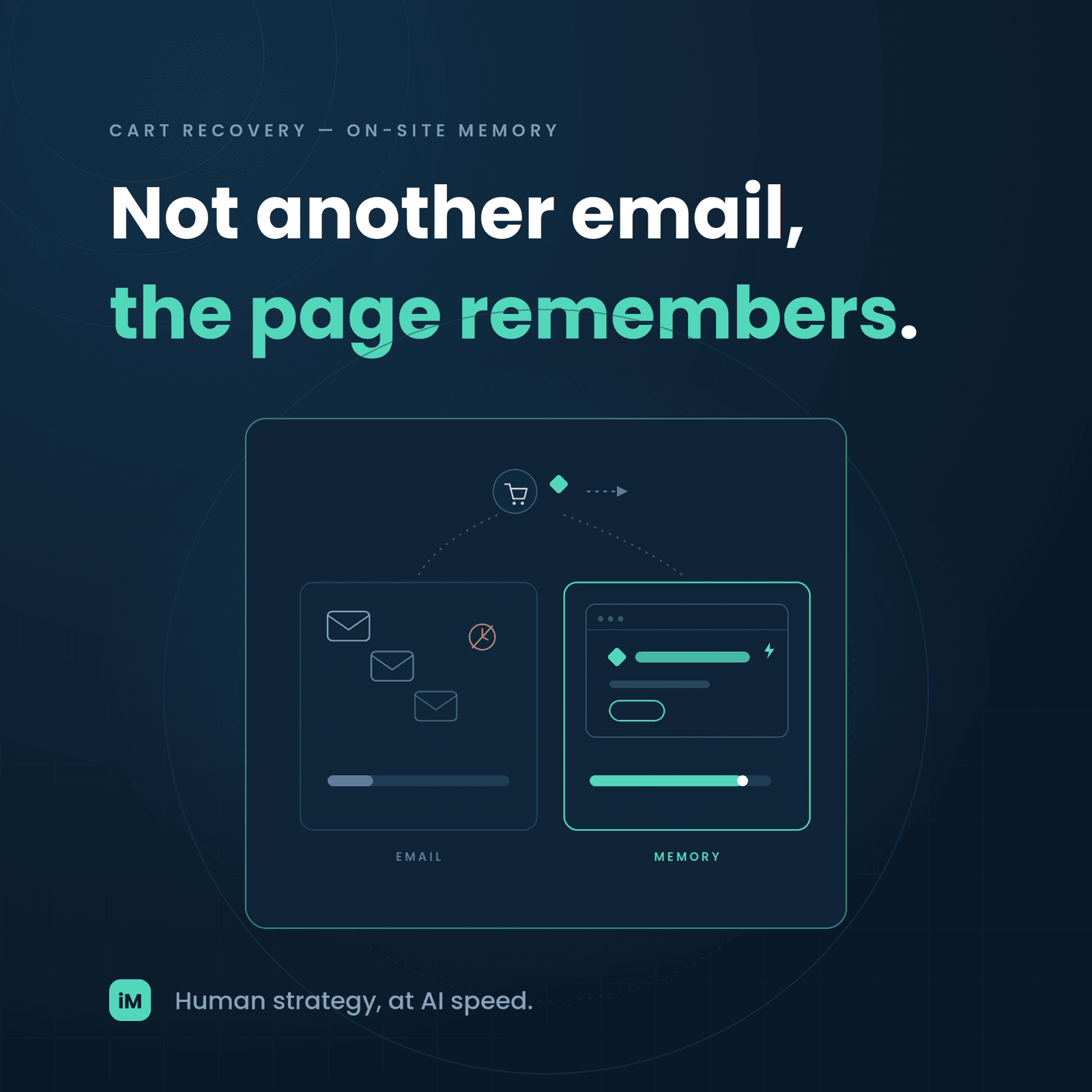
The uncomfortable truth is that the email is capturing the smallest possible slice of the abandonment recovery opportunity. The window in which a cart abandoner is most likely to convert is the window immediately after they leave — not four hours later when the first email fires, not two days later when the second email fires, and definitely not six days later when the discount code appears. The email works, but it works after the intent window that would have converted at three times the rate has already closed.
The actual highest-conversion opportunity is the moment the same visitor returns to the site on their own — through direct navigation, through a search result, through a bookmark, through a paid retargeting click. If the homepage they land on remembers what they were looking at and adapts accordingly, the recovery conversion rate approaches numbers the email campaign has never seen. This piece walks through why email retargeting misses the intent window, what on-site memory looks like in practice, and how the two channels compose.
The mechanical problem with email retargeting is latency. The abandonment event happens at the moment the visitor closes the browser tab. The email campaign fires on a schedule — typically 30 minutes, 4 hours, 24 hours, and 48 hours — and every one of those firings happens after the visitor has already moved on to whatever else was competing for their attention.
The behavioral reality of a cart abandoner is that the abandonment was usually not a decision to not buy. It was a decision to not buy right now. Something interrupted the session — a phone call, a meeting, a distraction, a comparison shop on another site — and the visitor left with the intention of coming back. The email that arrives four hours later interrupts a different context and asks the visitor to re-engage with a decision they had already deprioritized.
The visitor who does return of their own accord is the one who worked through the interruption and still remembered they were interested. That visitor is the highest-value recovery target in the entire abandonment audience — and the generic homepage they land on treats them like a stranger, forcing them to re-navigate to the product they had almost bought.
The second problem with email retargeting is that it competes for the visitor's attention against every other email in their inbox. A promotional email — even one with the visitor's abandoned product in the subject line — enters the inbox at the same time as fifty other promotional emails from other brands, and the visitor's response is to triage them all at once. The open rate reports 25%, which sounds good, but the click-through rate is closer to 5%, and the conversion rate on those clicks is another compounded fraction.
The visitor who returns to the site directly, by contrast, has already self-selected as active. They did not need an email to prompt them; they came back because the interest was still there. The site has the visitor's full attention for the next few minutes, and the only question is whether the homepage will meet the moment or squander it.
The generic homepage squanders it. The visitor who was looking at a specific washing machine on their last visit lands on a hero showcasing three unrelated categories, sees no reference to washers, and has to navigate through the site menu to find where they left off. The friction is small but not zero, and it competes against the residual doubt that made them leave the first time.
On-site memory is the specific practice of the homepage adapting to what the visitor was doing on their last visit. It is not a broad personalization exercise — it is a targeted rule that says 'if this returning visitor was viewing large appliances and left without buying, show the large-appliance hero with the specific model or category prominently on the homepage.'
The technical implementation is a first-party cookie or local storage entry that captures the last-viewed category or product, plus a rule engine that reads it at page load and swaps the hero accordingly. There is no CDP required, no data warehouse round-trip, no cross-device stitching to worry about — the memory is on the same device the visitor is using, and it works instantly when they return.
The specific power of on-site memory is that it activates in the moment of highest intent, without requiring the visitor to receive an email, open it, click it, and re-enter the site through the email link. The recovery path is direct: visitor returns, homepage recognizes the abandoned journey, hero swaps to the matched product, visitor completes the purchase.
The canonical browse-history rule is the abandoned-category rule: 'visitors who browsed [category] and left, show the [category] hero on the homepage on their next visit.' It is the highest-value single rule most enterprise programs can add, because it captures the specific segment with the highest known intent using a signal the site already has.
The rule composes with additional signals to become more targeted. 'Visitors who browsed washers, on desktop, from the primary market, returning within seven days' is a more specific rule than 'visitors who browsed washers,' and the specificity produces higher conversion. The rule library grows over time as the marketing team observes which combinations pay off and adds targeted variants.
The pattern also inverts. 'Visitors who browsed and completed a purchase in the last thirty days, do not show the abandoned-cart hero — show the loyalty or accessory hero instead.' The rule set has to know both when to remember and when to move on. Reflex-style rule engines handle both cases in the same panel where the acquisition rules live.
On-site memory does not replace email retargeting. It complements it. The two channels reach different segments of the abandoner audience: on-site memory reaches the visitors who return on their own, email retargeting reaches the visitors who do not. The right operating model uses both, with the email reserved for the segment that does not self-return within the first 24-48 hours.
The measurable outcome of running both is that the aggregate recovery rate on the abandoner audience roughly doubles compared to running email alone. The lift comes from the previously unaddressed segment of self-returners who were converting at a fraction of their potential rate. The email campaign continues to work on the segment it was already reaching.
The finance case for adding on-site memory is unusually clean. The infrastructure cost is a rule engine that the marketing team already has (or is a rule set inside the existing personalization module). The measurement cost is zero — the recovery rate is visible in the same conversion reporting that already covers the email campaign. The addressable lift is the specific gap between the self-return conversion rate under the generic homepage versus under the memory-aware homepage, and it is usually substantial.
The email arrives four hours after the intent window closed. The homepage that remembers the visitor meets the intent window the moment it reopens.
Adding on-site memory does not require a new platform. It requires a lightweight cookie or storage entry, a rule that reads it, and a hero variant matched to the abandoned category. The first-month goal is one rule — the abandoned-category rule — and a clean measurement of the recovery lift against the pre-rule baseline.
inMOLA's Reflex module reads the visitor's prior browsing signal — the last category or product viewed, the abandonment event, the recency of the last visit — and swaps the hero, banner, and call-to-action to match on the very next visit. The rule lives in the same panel as the acquisition rules, and the recovery conversion rate is visible in the same view. The channel that used to run entirely on email now runs on email plus a homepage that meets the returning visitor where their intent still lives.
The email retargeting investment is not wasted. It is just partial. Adding on-site memory closes the segment of the abandoner audience the email was never going to reach in time, and the recovery numbers move accordingly.
Customer Intelligence & Retention
Customer Intelligence & Retention
Customer Intelligence & Retention