Customer Intelligence & Retention
Real-Time Web Personalization · 2026년 7월 14일 · 9 분 읽기
A/B testing finds the variant that performs best on average. That variant is a compromise between segments that would have preferred different content. Rule-based personalization delivers the per-segment optimum, and the aggregate conversion rate follows.
For two decades, A/B testing has been the credibility standard for website optimization. Two variants of a hero, a headline, or a button run against each other on split traffic, the winner is declared with statistical confidence, and the losing variant is retired. The winning variant becomes the new baseline, and the next test cycle begins. The discipline is real, and the confidence intervals are real, and the practice has produced measurable lift on countless sites.
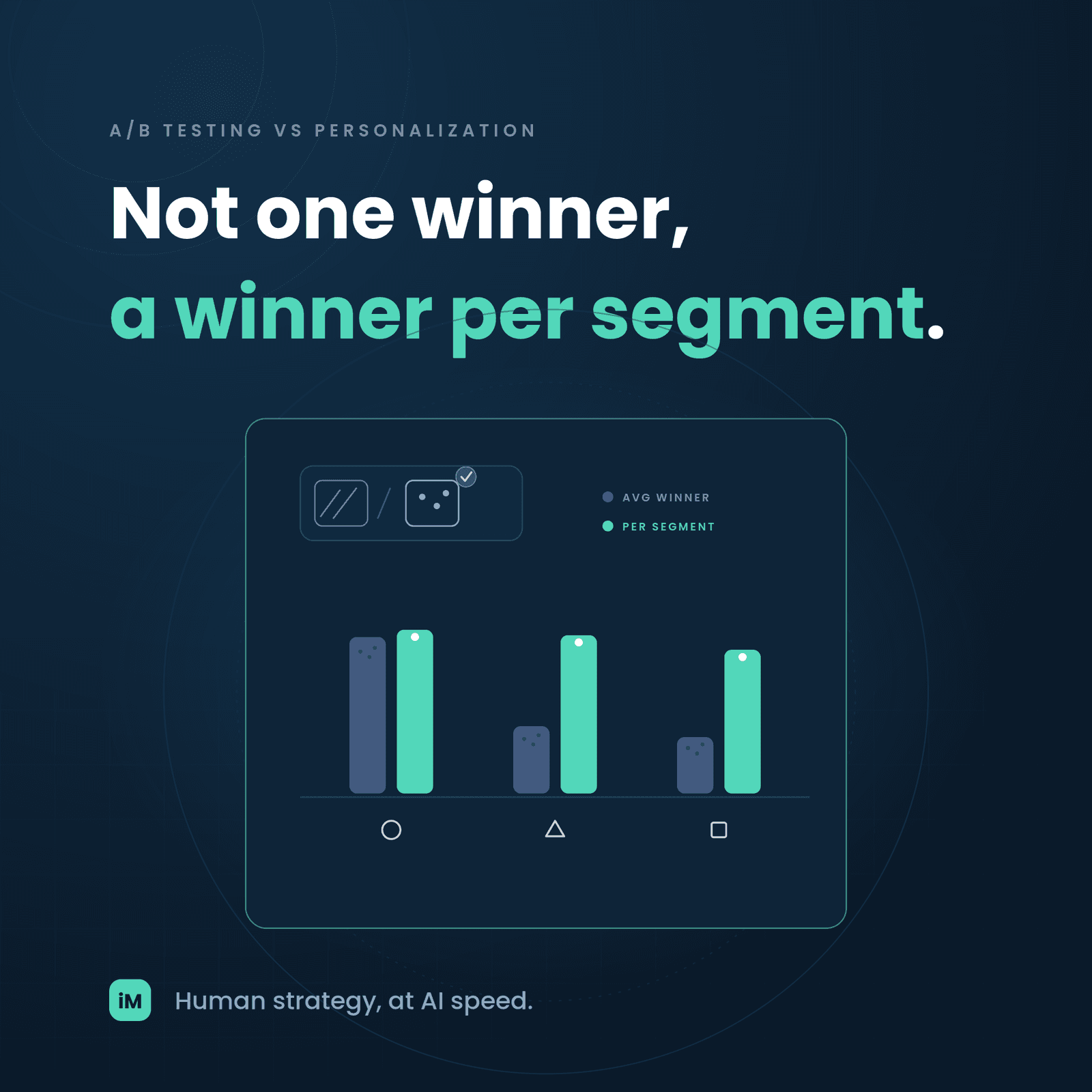
The problem the practice hides is that the winning variant is still a compromise. It is the variant that performed best on average across the mixture of segments in the test traffic. But the segments inside that mixture responded differently — some segments would have preferred the losing variant, and the winning variant lost those conversions in exchange for the segments where it did better. The aggregate winner is a specific compromise between segments that wanted different things.
Rule-based personalization ends the compromise by delivering the per-segment optimum instead of the aggregate winner. This piece walks through what A/B testing actually optimizes for, where the segment-optimization gap sits, when personalization wins versus when A/B still wins, and what the hybrid pattern most enterprises land on looks like in practice.
The mathematics of A/B testing are unambiguous — the test declares a winner when one variant beats the other with sufficient statistical confidence, on the aggregate conversion rate of the traffic that was randomly assigned to each variant. The declaration is honest and rigorous, but the metric being optimized is the average across the mixture, not the optimum for any particular segment.
The consequence shows up when the winning variant is broken down by segment. It is common to find that the winning variant beat the losing variant overall while losing to the losing variant on a subset of segments. The aggregate result was driven by the segments where the winning variant did well; the losing segments were quietly overridden by the aggregate math.
The specific example is worth spelling out. A hero test between 'Save 20% today' and 'Free shipping on your first order' declares 'Save 20% today' the winner by 8% conversion lift. Segmented analysis reveals that first-time visitors preferred the discount by 15%, but returning shoppers preferred free shipping by 12%. The aggregate winner captures the first-time visitor lift; the returning shopper loss is absorbed into the winner's favor because first-time visitors outnumber returning shoppers in the test.
The 12% lost on returning shoppers is not a rounding error. It is a specific per-segment optimum that the aggregate winner cannot deliver. In an A/B world, that lift is unrecoverable — the losing variant was retired, and the returning shoppers now see the winning variant that they preferred less.
The gap between the aggregate winner and the per-segment optimum is not always large, but it is almost always non-zero. In enterprise programs with substantial audience diversity, the gap is often the largest remaining conversion opportunity — larger than any individual A/B lift the team is still hunting.
The gap widens when the audience is bimodal or trimodal. A site serving both first-time buyers and returning customers, or both consumer and small-business audiences, or both primary-market and international visitors, will have larger per-segment optima than a site serving a homogeneous audience. Every additional axis of audience diversity is a larger gap between the aggregate winner and the segment-served optimum.
The A/B testing loop cannot close this gap by itself, no matter how many rounds it runs. Each round produces another aggregate winner, and each aggregate winner is another compromise. The only way to capture the segment-specific optimum is to serve different content to different segments, which is what rule-based personalization does.
The two disciplines are not competing methodologies for the same problem. They optimize different variables. A/B testing optimizes the variant that goes to a specific segment; rule-based personalization decides which variant each segment sees. Used together, they compound — A/B testing finds the best hero for the abandoned-cart segment, personalization ensures the abandoned-cart segment sees that hero and only that hero.
A/B testing is still the right tool for universal changes — a site-wide navigation redesign, a checkout flow overhaul, a color scheme change, or any test where the winning variant genuinely should apply to everyone. The lift a well-designed A/B test produces on a universal change is real, and personalization does not replace it.
Personalization is the right tool when different segments demonstrably want different things. Cart abandoners want a different hero from first-time visitors. Paid-ad clickers want a different hero from organic searchers. Regional visitors want different pricing anchors from primary-market visitors. Each segment has a per-segment optimum, and the aggregate A/B winner is a compromise the personalization rule set avoids.
The mistake most programs make is picking one methodology and defending it. The A/B-only shop leaves segment optima on the table; the personalization-only shop misses the aggregate optimization opportunity that only rigorous A/B can produce. The correct posture is running both, using each where it applies, and letting them compound.
The mature enterprise pattern uses A/B testing to find the best variant for each segment, then uses personalization to serve that variant to that segment. The two disciplines feed each other.
The measurable outcome of this pattern is that the aggregate conversion rate improves faster than either discipline could produce alone, and the improvement is defensible because every rule has an A/B test behind it. The finance conversation about optimization ROI gets sharper because the improvement is decomposable — 'this rule added 3% to this segment, this rule added 5% to that segment, the aggregate lift is the weighted sum.'
The most common reason enterprise programs stop short of the hybrid pattern is that the reporting gets harder. Aggregate conversion rate is one number; per-segment conversion rate with rule attribution is many numbers, and the analytics stack has to keep them all aligned. The teams that solve the reporting first tend to be the ones that fully commit to the pattern.
Reflex-style personalization solves part of the reporting problem by exposing per-rule impressions, clicks, and conversions in the same view where the rule is built. The marketer who publishes a rule sees the rule's measurable outcome without stitching together three analytics tools. The A/B test that fed the rule is documented alongside it, so the reasoning behind the rule is visible when the next iteration is being planned.
The organizational implication is that the optimization discipline moves from a periodic project run by a specialist to a continuous practice owned by the marketing team. The specialist role does not disappear — the segment analysis, the test design, the confidence interval discipline still requires expertise — but the day-to-day authoring of rules becomes a marketing function rather than an engineering ticket.
The winning variant of an A/B test is a compromise. Every segment that preferred the losing variant is a specific opportunity the winner does not deliver. Personalization ends the compromise.
Moving from A/B-only to A/B-plus-personalization does not require abandoning the A/B discipline. It requires identifying two or three segments where the audience demonstrably responds differently, running segmented A/B tests to find each segment's best variant, and using a rule engine to serve each variant to its segment. The first-month goal is two or three rules with clean segmentation and clean measurement, not a comprehensive personalization deployment.
inMOLA's Reflex module runs the personalization layer in parallel with whatever A/B testing framework the marketing team already uses. Rules can be seeded from A/B test winners, published in minutes, and measured per-rule in the same view where they were authored. The A/B test remains authoritative for discovering the best variant within a segment; the rule engine handles the routing that ensures each segment sees its winner.
The A/B testing discipline that has produced website optimization gains for two decades is not obsolete. It is one half of the hybrid pattern. The other half — the rule engine that ensures each segment sees the variant it actually preferred — is the part most enterprise programs are still missing, and the compounding lift over four quarters is substantial.
Customer Intelligence & Retention

Customer Intelligence & Retention

Customer Intelligence & Retention