Customer Intelligence & Retention
Customer Intelligence & Retention · 17 de julio de 2026 · 8 min de lectura
The default win-back campaign fires the same discount code at every lapsed customer. Most of the budget lands on customers who were never coming back, the recovery rate is a fraction of what it looks like, and the margin damage compounds every quarter.
Every consumer marketing team's win-back campaign runs on roughly the same logic. A customer has not purchased in 60 days, or 90, or 180. The retention automation fires a sequence — 'we miss you,' followed by a 10% discount, followed by a 20% discount, followed by a final 25% or free-shipping offer. The campaign reports back a recovery rate that everyone agrees justifies the spend, and the sequence keeps firing quarter after quarter.
The uncomfortable truth is that most of the win-back budget is landing on customers who were never coming back regardless of the offer. The recovery rate reported in the campaign dashboard is inflated by two invisible factors — customers who would have returned without the offer are credited to it, and customers who accept a discount but never re-engage after that single purchase are counted as recovered when they are actually just discount hunters passing through.
This piece walks through the specific mechanics of win-back budget waste, how to identify the segment that is actually recoverable, and what changes when the win-back program stops firing at the whole lapsed base and starts firing at the specific customers where recovery is possible.
The lapsed customer segment — the population the win-back campaign is targeting — is not one population. It contains at least three distinct groups, and the three groups respond very differently to the same win-back offer.
The first group is the customers who would have returned on their own. Their absence from the base is not a lapse — it is a normal gap between purchases in a category with a naturally low frequency. Sending them a 25% discount code accelerates the return by a few days at the cost of the margin they would have paid at full price. The campaign dashboard credits the return to the offer, but the true incremental effect is negative.
The second group is the customers who are genuinely slipping but recoverable — the segment the win-back program is actually designed for. Their return is contingent on the right intervention, and the right intervention is often not a discount. It might be a service recovery for a bad prior experience, a targeted offer on a category they actually buy, or a re-engagement message that reminds them of the specific product they were considering. A generic discount to this segment produces some recovery but at a lower rate than a matched intervention would.
The third group is the customers who are not coming back regardless of the offer. Their departure has already happened in operational terms — they moved away, they exited the category, they switched permanently to a competitor, or the initial purchase was a one-off that was never going to become a relationship. Every dollar the win-back campaign spends on this group is a dead loss.
The mathematics of the reported recovery rate hide the waste. A win-back campaign firing at 10,000 lapsed customers and producing 800 returning purchases reports an 8% recovery rate, which sounds acceptable. The problem is that of those 800 returns, perhaps 300 would have returned without the offer, 300 are genuine recoveries that responded to the intervention, and 200 are one-time discount hunters who took the deal and did not become recurring customers.
The true incremental recovery — the customers who returned because of the campaign and who continued to purchase after the initial recovery — is 300 out of 10,000, or 3%. The reported 8% is masking the 500 responses that were either non-incremental or non-sustained. The finance team defending the win-back spend against the reported 8% is defending a number that overstates the true impact by more than 2x.
The compound effect is that the win-back program looks profitable on the current-quarter dashboard and unprofitable when the full cost-of-margin-on-non-incremental-recoveries is measured against the lifetime value of the true incremental recoveries. Most enterprise programs never do that measurement because the math is uncomfortable and the reporting infrastructure was built to produce the flattering number.
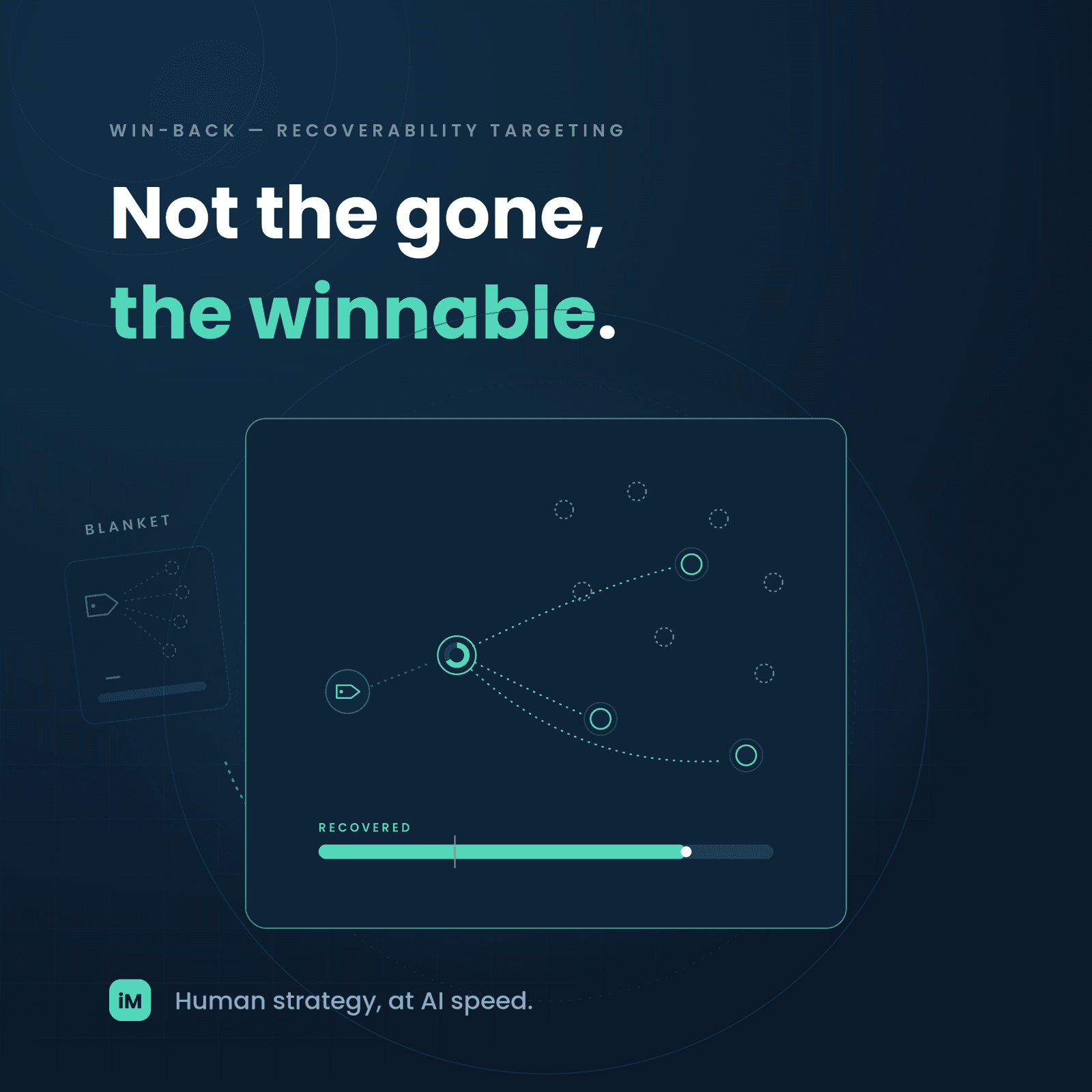
Separating the three populations requires scoring individual customers on their recovery probability, not treating the lapsed segment as one bucket. The score reads the customer's pre-lapse behavior, the specific pattern of the lapse, the category and product mix that characterized the relationship, and the engagement signals in the period after the last purchase.
The high-recovery-probability segment usually has three consistent signatures. First, a pre-lapse pattern of strong engagement — the customer was in the Loyalist or high-Casual tier before the slip, so the relationship exists and can be reactivated. Second, a slip that has an identifiable cause — a service event, a price event, a category-adjacent competitor launch — that the intervention can address. Third, continued engagement signals in the lapsed period — email opens, site visits without purchases, cart activity that did not complete — that indicate the customer has not fully disengaged.
The low-recovery-probability segment shows the opposite signatures. Weak pre-lapse engagement suggesting the customer was already loosely attached. A slip with no identifiable trigger, suggesting drift rather than a recoverable event. Zero engagement signals in the lapsed period, indicating the customer has moved on. The offer to this segment is not going to recover them regardless of the discount depth.
The recoverable segment does not need the same intervention across the board. It needs a diagnostic-matched intervention that addresses the specific reason for the slip.
The intervention set is more complex than a single generic discount, but the recovery rate on the smaller targeted segment is materially higher, and the margin damage on the non-recoverable segment stops entirely. The net effect on the win-back program's incremental revenue is positive even though the total spend drops.
The finance conversation about the win-back program changes in three specific ways after the shift. First, the reported recovery rate is lower — because the non-incremental recoveries are no longer being credited to the campaign — but the incremental recovery rate is higher because the intervention is landing on the segment that actually responds. Second, the total spend drops materially because the campaign is not firing on the non-recoverable segment. Third, the CAC-on-recovered-customers reads correctly because the denominator is the true incremental recovery, not the inflated aggregate.
The CFO comparison of retention program economics gets sharper. Instead of defending an aggregate ROI that the operator half-knows is inflated, the marketing team can defend a per-segment ROI that stands up to scrutiny. The retention line moves from a shared point of skepticism between marketing and finance to a shared point of confidence, and the budget conversation the next quarter starts from a defensible base.
The 8% recovery rate on the win-back campaign is not the recovery rate. It is what the campaign looks like before the non-incremental and one-time discount hunters are subtracted out. The true rate is a fraction of that, and the wasted spend is what the true number leaves behind.
Fixing the win-back program does not require killing the campaign. It requires scoring the lapsed segment individually, firing the campaign only at the high-recovery-probability segment, matching the intervention to the specific slip signature, and measuring the incremental recovery rate honestly against the pre-shift baseline.
inMOLA's Customer Score module scores every lapsed customer on recovery probability, categorizes the slip signature, and matches the intervention to the specific cause. The win-back program stops firing at the whole lapsed base and starts firing at the specific customers where the intervention lands. The total spend drops, the true recovery rate lifts, and the margin damage on the non-recoverable segment ends.
The generic win-back campaign is not going to disappear from the retention marketing playbook. But the marketing programs that stop treating the lapsed segment as one population will spend the next four quarters producing measurably better returns on materially less spend than the programs still firing 25% discount codes at customers who were never coming back.
Customer Intelligence & Retention
Customer Intelligence & Retention
Customer Intelligence & Retention