
Customer Intelligence & Retention
Ad Performance & Attribution · 4 de julio de 2026 · 8 min de lectura
Ranking Meta against Google against TikTok on a single metric — CTR, ROAS, CPC — hides more than it reveals. A composite channel score changes what a marketing team argues about, and what they optimize toward.
Every marketing review begins with the same question. Which channel performed best last month. The answer is nearly always given as a single metric: highest ROAS, lowest CPC, best CTR. The winning channel gets a budget bump, the losing channel gets a spending cut, and the meeting moves on. The problem is that the ranking almost never survives contact with the next quarter.
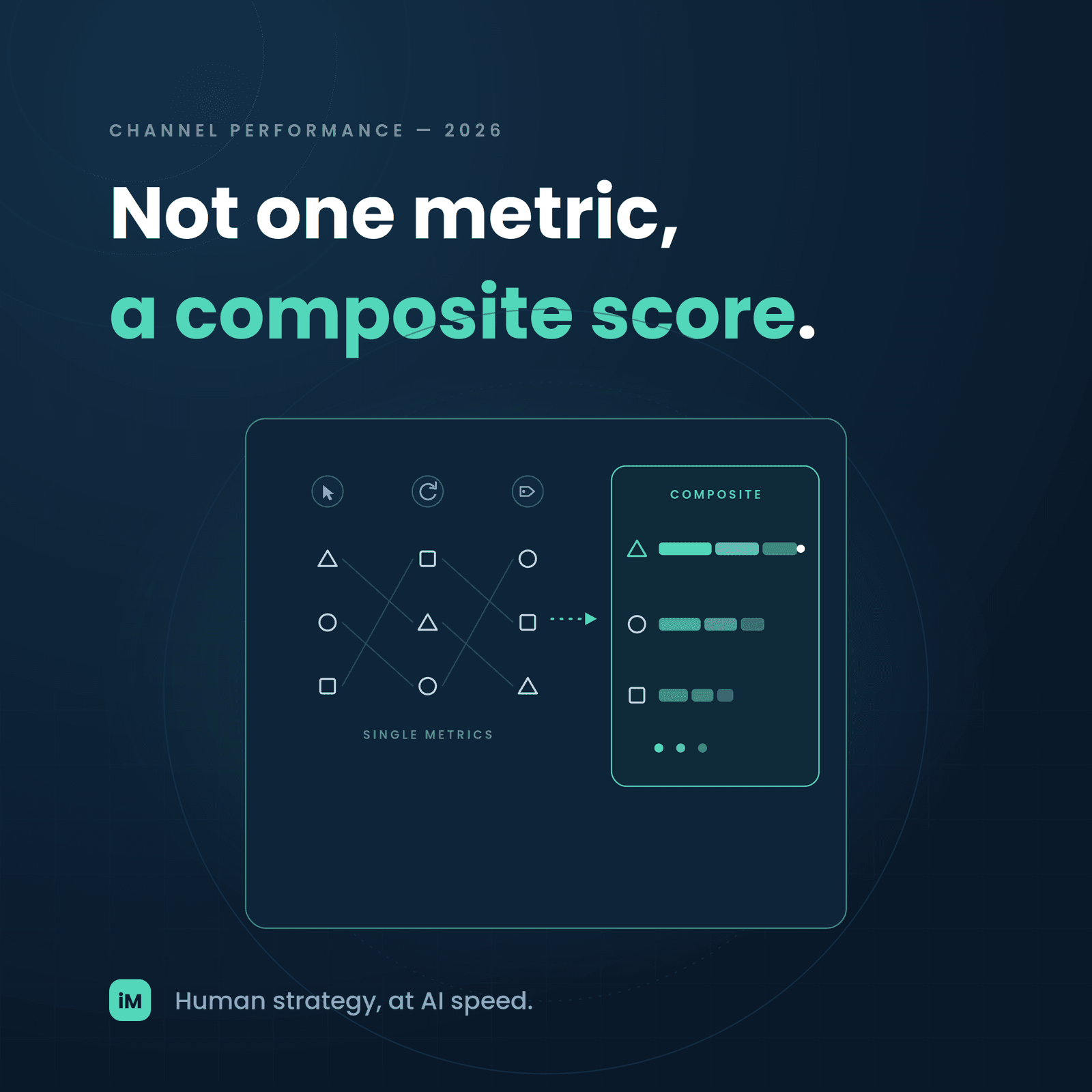
The reason it does not survive is not that the metric was wrong. It is that no single metric describes channel performance. A channel with a high ROAS but declining CTR is not the same as a channel with a high ROAS and rising CTR. A channel with cheap CPCs but no audience interest signal is not the same as a channel with expensive CPCs and a compounding audience. Yet single-metric ranking treats them as equivalent, and the reallocation decision that follows is systematically wrong.
The 2026 correction is a composite channel score. Not because scoring is fashionable, but because it is the only way to make an apples-to-apples comparison honest across Meta, Google Search, Shopping, YouTube, LinkedIn, TikTok, and X. This piece walks through why the single-metric habit persists, what a composite score actually measures, and what changes in a marketing team once the discipline lands.
The reason single-metric ranking feels rigorous is that it produces a definite answer. Meta ROAS 3.8 beats TikTok ROAS 2.4, so Meta wins. The rigor is illusory. ROAS is a lagging outcome that reflects what already happened; it does not describe the conditions that produced it or the trajectory of those conditions. A channel can post the highest ROAS in the deck while its CTR is compressing, its CPCs are climbing, and its audience is fatiguing — and the ROAS number will not warn you until the collapse is already priced in.
CTR alone is worse. A high CTR at the wrong audience produces expensive traffic that never converts. A low CTR at the correct audience produces cheap qualified traffic that closes. Ranking by CTR reallocates budget toward whichever channel best matches the industry click benchmark, which is not the same as whichever channel best matches your specific product's demand.
CPC alone is worse still. Low CPCs are a downstream result of relevance, competition, and format, not a virtue in themselves. A channel with expensive CPCs and high conversion rates can outperform a channel with cheap CPCs and no conversion path. Ranking by CPC systematically punishes the exact channels that carry qualified upper-funnel intent.
A composite score is not a random weighting of the individual metrics. It is a structured combination that captures four axes of channel performance simultaneously: click efficiency, cost efficiency, sales momentum, and audience interest. Each axis is normalized against the channel's own baseline and against the category baseline, so comparison across channels is honest even when their raw numbers are on different scales.
Click efficiency reads CTR against the channel's trailing baseline and against benchmark ranges for the format. A CTR that would look weak in a Meta feed can look strong in a LinkedIn sponsored post, and the score respects that.
Cost efficiency reads CPC and CPM against local competitive dynamics. A CPC that is objectively expensive can still be efficient if the competitive set is expensive and the conversion rate justifies it. Cost efficiency answers the more useful question: is this channel returning value per dollar relative to the alternatives available to it, not to a global benchmark.
Sales momentum reads revenue and conversion trajectory, not just point-in-time ROAS. A channel producing a stable ROAS on falling volume is not the same as a channel producing a stable ROAS on rising volume. The trajectory matters more than the snapshot.
Audience interest reads engagement depth, retention, and repeat interaction. A channel that produces one-touch traffic that never returns is different from a channel that produces compounding audience — and the score separates them.
The reason a composite score is necessary is that channels are not comparable on raw metrics. Meta and Google Shopping are not the same auction. YouTube in-stream is not the same format as a LinkedIn sponsored post. TikTok's algorithmic distribution does not behave like X's chronological feed. Comparing them on a shared ROAS number is like comparing sprinters and marathoners on average speed — the number exists, but it hides the thing you actually need to know.
The five distortions that break single-metric comparison are: funnel-stage mismatch (Search captures existing intent, Meta creates it), auction dynamics (Google keyword auctions vs Meta interest auctions), attribution windows (last-click captures Search, misses Meta's assist), audience overlap (LinkedIn and Meta may hit the same buyer, and only one gets credit), and format economics (in-feed video does not compete on the same cost curve as search text ads).
A composite score does not eliminate these distortions — nothing does. It surfaces them. When a channel scores well on interest but poorly on sales momentum, the score is telling you the channel is doing upper-funnel work that the last-click attribution model is missing. That is a useful piece of information that a ROAS-only view suppresses entirely.
The score itself is a number from 0 to 100, but the operational value comes from the bands. Five bands, each with a specific action, each defensible in front of a CFO.
The bands are what turns the score from analysis into a decision framework. A performance review is no longer a debate about whose channel is best — it is a review of which bands each channel is in and what specific action the band prescribes.
The first thing that changes is the tone of the weekly review. The argument shifts from 'my channel is better than your channel' to 'the channel is in the Watch band because audience interest is compressing — here is the refresh plan.' The metric argument becomes a diagnostic argument.
The second thing that changes is the reallocation decision. Instead of moving budget after a monthly ROAS ranking, budget moves when a channel crosses a band boundary. The move is smaller, more frequent, and more defensible.
The third thing that changes is the historical comparison. A score band history is a real record of channel behavior over time. A channel that spent six months oscillating between Watch and Refresh is a different asset than one that held Scale for the same period, even if their trailing ROAS looks similar.
The measurable advantage of running a scored channel review is that the reasoning behind reallocation becomes portable. A new marketer joining the team can read the score history and understand what each channel is for. A CFO reviewing the media plan can read the band distribution and understand where the risk sits. A CEO reading the executive briefing sees a score trend, not a metric snapshot.
The channel that wins the monthly ROAS ranking is not necessarily the channel that will win the quarter. A composite score is the only way to know which is which before the next allocation goes out.
The transition from single-metric ranking to composite scoring does not require a platform migration. It requires deciding that the marketing team will argue about score bands, not about which metric ranks channels this week. Once that decision is made, the discipline builds itself — the score history accumulates, the band boundaries become team-shared instincts, and the reallocation conversations get sharper.
inMOLA's Advertisement module runs this discipline continuously across Meta, Google (Search, Shopping, Display, Performance Max, App), YouTube, X, LinkedIn, TikTok, and other channels — scoring each on click efficiency, cost efficiency, sales momentum, and audience interest, and surfacing the band each channel currently sits in with the specific action the band prescribes.
The single-metric habit is not going to die overnight. But the marketing teams that move first to composite scoring will spend the next four quarters making sharper allocation decisions than the ones still ranking channels by whichever metric happened to look best last week.
Customer Intelligence & Retention

Customer Intelligence & Retention
Customer Intelligence & Retention