Customer Intelligence & Retention
Ad Performance & Attribution · 7. Juli 2026 · 8 Min. Lesezeit
GA4's last-click default gives Search the credit and starves the channels that actually created the demand. UTM discipline and multi-touch attribution close the gap between what your dashboard reports and what your buyers actually do.
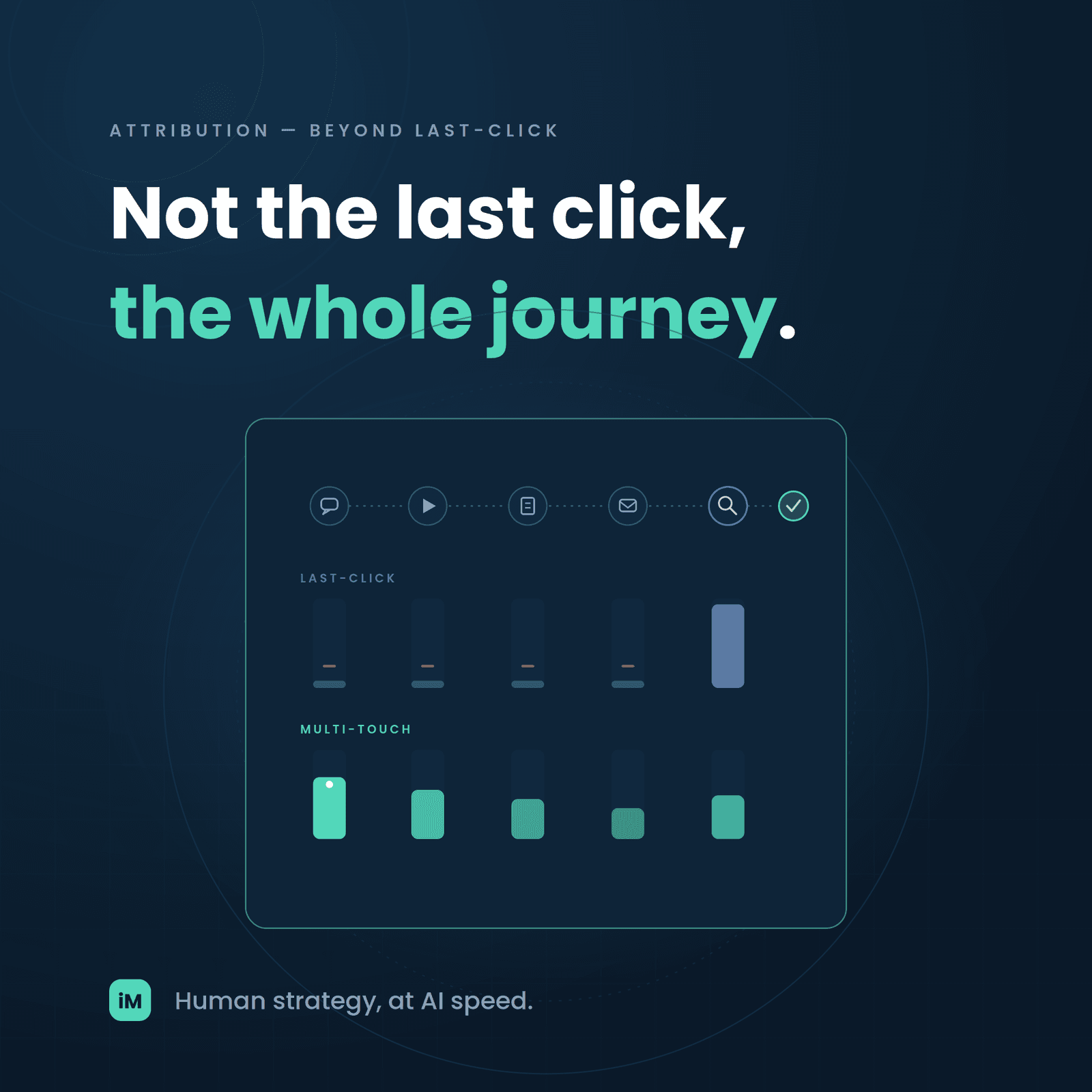
The single most consequential number in most marketing dashboards is a lie, and everyone in the marketing team knows it. Last-click attribution assigns 100% of the conversion credit to the final touch before the purchase. In practice that final touch is almost always a branded Search click. The result is that Search looks like the highest-performing channel, and the channels that actually created the demand — Meta, TikTok, YouTube, LinkedIn — look weaker than they are.
The consequence is not academic. Budget reallocation decisions get made against this attribution model. Meta gets a cut because 'the ROAS is lower.' Search gets a boost because 'the ROAS is higher.' Six months later, Search ROAS has quietly declined because the demand pipeline that Meta was feeding it has dried up, and the team cannot figure out why.
This piece walks through why last-click persists despite being systematically misleading, what a truthful attribution model actually looks like, and the specific UTM discipline that makes multi-touch attribution real rather than aspirational.
The average B2C purchase decision in 2026 involves 6-12 touchpoints across a mix of paid ad channels, organic content, review platforms, and branded search. The B2B decision involves 15-30. A single-touch attribution model captures at most one of them. The other 5-29 are treated as though they did not happen.
The buyer journey pattern is not new. What is new is that the attribution tooling is finally catching up to it. Multi-touch attribution assigns fractional credit to each touchpoint along the path, with the fractional weight determined by an attribution model (position-based, time-decay, data-driven, or platform-specific). The point of the exercise is not to produce a mathematically perfect answer — it is to produce a directionally correct one, which last-click structurally cannot.
The specific misallocation that last-click produces is systematic upper-funnel undervaluation. Every touch before the final one — the Instagram ad that introduced the brand, the YouTube video that built consideration, the LinkedIn post that established authority — gets zero credit. The channels that create demand are treated as though they cost money and produce nothing, while the channel that captures the demand at the last moment (Search) is treated as though it created the entire outcome.
The mathematics of last-click undervaluation are worth spelling out. Consider a buyer who sees a Meta ad on Monday, watches a YouTube video on Wednesday, searches the brand name on Friday, and converts. Last-click assigns 100% of the conversion value to Search. A multi-touch model with reasonable defaults might assign 40% to Meta, 30% to YouTube, and 30% to Search.
The difference matters for reallocation. Under last-click, Search shows a $50 revenue per click and Meta shows $0. The obvious move is to shift budget to Search. Under multi-touch, Search shows $15 revenue per click and Meta shows $20. The move is the opposite.
The reason last-click is not just wrong but harmfully wrong is that the misallocation is self-reinforcing. Cutting Meta budget reduces the demand pipeline that feeds Search. Search ROAS then declines because there is less brand-searched demand to capture. The team responds by cutting Meta further — and the death spiral continues until the brand loses category share and the CMO gets asked why paid marketing stopped working.
The other force that has been degrading attribution accuracy is the shift toward user-privacy-first tracking. iOS 14's App Tracking Transparency, third-party cookie deprecation, and the platform-specific attribution APIs that replaced them have all narrowed the visibility of the full buyer journey. The result is that even platforms that used to report multi-touch data now report progressively less of it.
The response is not to give up on attribution — it is to move the ground truth to the first-party layer that the brand controls. UTM parameters on every outbound link, first-party analytics that respect the UTM, and a stable conversion event definition that survives platform changes. The UTM discipline becomes the attribution layer of last resort, and it is the layer least affected by platform tracking changes because the brand controls it directly.
The specific practice that pays off is running UTMs on every paid link, every organic social post, every email link, and every partner placement. The UTM tells the brand's own analytics stack what channel and campaign produced the visit, independent of whatever the platform reports back. Over time, the first-party attribution log becomes more reliable than the platform-reported attribution because the platform reports have been degrading while the first-party log has been improving.
UTM discipline sounds mundane. It is one of the highest-leverage practices in a modern paid program. The reason is that inconsistent UTMs are the single most common cause of attribution collapse in enterprise marketing dashboards.
The five UTM parameters are source, medium, campaign, term, and content. The reason attribution collapses in most enterprise dashboards is that different agencies, freelancers, and internal team members use different naming conventions. 'facebook' vs 'Facebook' vs 'fb' all map to different rows in analytics. 'summer-sale-2026' vs 'SummerSale2026' vs 'summer_sale' all fragment the same campaign.
The discipline is a naming convention document, enforced through a UTM builder that the whole team uses. The builder auto-populates the source and medium from a controlled dropdown, requires the campaign name to match a template, and lints the values before publishing. Ten minutes of tooling in front of the discipline saves months of dashboard cleanup after.
The compound value of clean UTMs is that every channel's true contribution becomes visible in the first-party layer, and multi-touch attribution can be run on that layer with confidence. Attribution stops being an argument about which platform's numbers to trust and becomes an argument about which attribution model to apply to the same clean dataset.
The changes that flow from moving off last-click are more organizational than technical. The reallocation conversation changes first. Meta and YouTube become defensible investments even when their platform-reported ROAS looks weak. Search becomes defensible as a capture channel rather than a creation channel, and the budget conversation stops framing Search as the 'always-winning' allocation destination.
The creative brief changes next. Upper-funnel creative gets briefed against demand-creation metrics — reach, brand lift, category recall — rather than against last-click ROAS that will never fairly reflect its contribution. The creative team stops fighting a battle that the attribution model was rigged against.
The measurement conversation with finance changes third. A CFO who has seen the same 'Search dominates ROAS' story for years sees a materially different picture when multi-touch attribution reveals Meta as a demand-creation asset. The paid marketing budget is no longer 'the Search line and everything else' — it is a portfolio of channels doing different work at different points in the funnel.
Moving off last-click does not require a platform migration. It requires deciding that the marketing team will report on multi-touch attribution, enforce UTM discipline as an operational practice, and reallocate against multi-touch numbers rather than last-click numbers. Once that decision is made, the discipline builds itself — the UTM library gets built, the multi-touch dashboards get set up, and the reallocation conversations shift.
Last-click attribution is the marketing equivalent of giving the goalkeeper credit for every goal. It is not that the goalkeeper does not matter — it is that the reallocation logic falls apart the moment you actually believe the number.
The programs that continue to reallocate against last-click will keep starving the channels that produce their demand. The programs that move to multi-touch with clean UTM ground truth will see the full portfolio, allocate against the real contribution, and compound the advantage over four to eight quarters.
inMOLA's Advertisement module includes a UTM builder that enforces naming discipline, an attribution layer that reads the first-party UTM log, and multi-touch reporting that surfaces each channel's real contribution — so the reallocation conversation happens against numbers that reflect what buyers actually do.
Customer Intelligence & Retention
Customer Intelligence & Retention
Customer Intelligence & Retention