Customer Intelligence & Retention
Ad Performance & Attribution · 6. Juli 2026 · 9 Min. Lesezeit
The annual media plan built in December for the following year survived when audience behavior moved slowly. It does not survive 2026 auction dynamics. Continuous AI-driven reallocation is the new operating rhythm.
For thirty years, the annual media plan was the closest thing marketing had to a strategic instrument. In November or December, the CMO's team would build a channel-by-channel allocation for the year ahead, present it to finance, defend the numbers in a budget meeting, and then execute against the plan until Q4 review. The plan was often wrong, but the environment moved slowly enough that being wrong once a year was survivable.
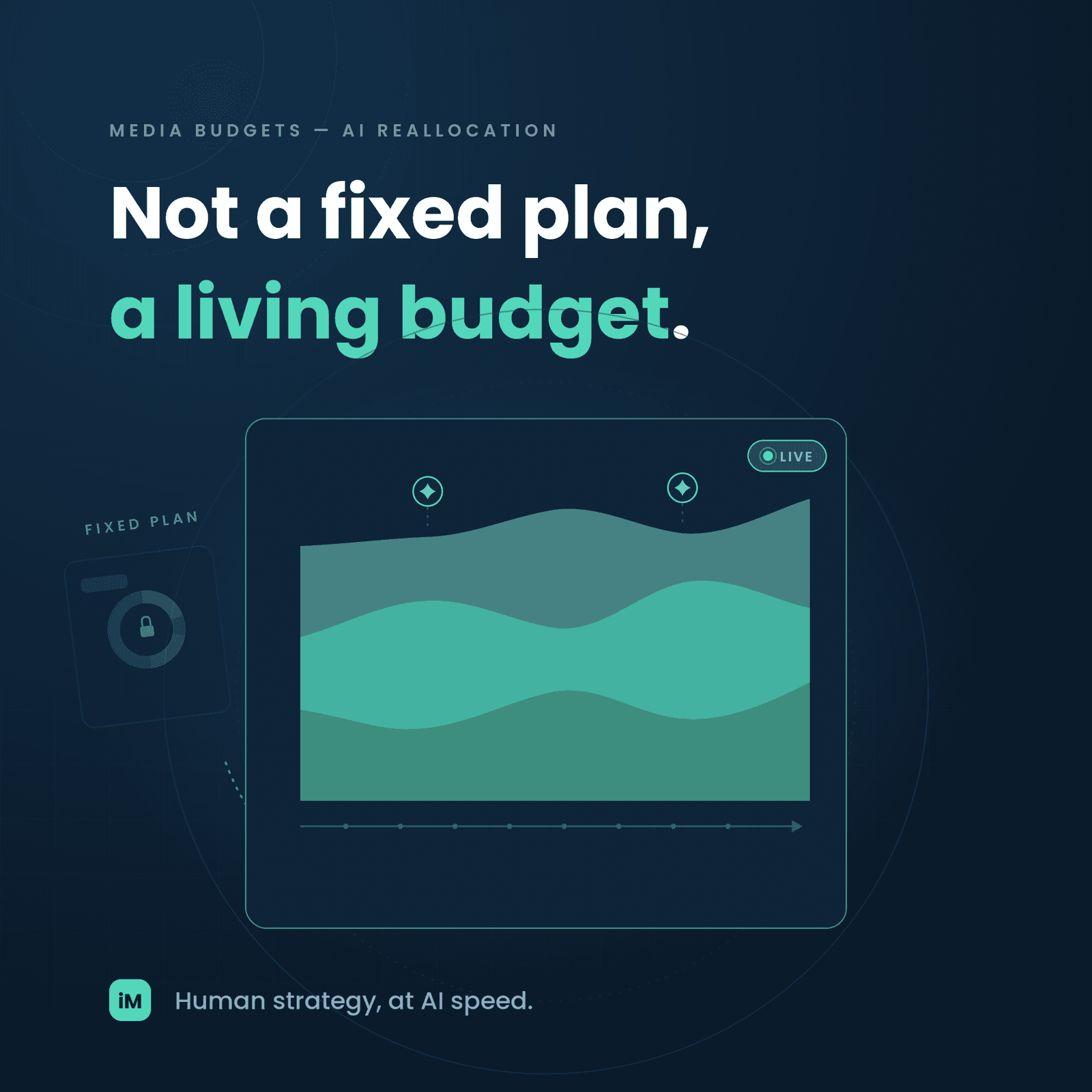
In 2026 that plan does not survive the first quarter. Auction dynamics move weekly. Platform algorithms reoptimize daily. Audience attention shifts across channels faster than any human planning cycle can track. The fixed media plan is not a strategic instrument any more — it is a starting position, and the actual work is continuous reallocation.
This piece walks through what continuous AI budget reallocation actually does, what makes it different from monthly performance reviews, and where the humans still need to hold the pen.
The mathematical reason fixed plans fail is that channel performance is non-stationary. The ROAS distribution on Meta in January is not the ROAS distribution on Meta in March, even for the same brand, product, and campaign structure. The distribution shifts because the audience shifts, the competitive set shifts, the platform algorithm shifts, and the creative fatigues.
A fixed plan built on January performance data allocates budget to whichever channel looked best in January. Three months later, the January-best channel may be in the middle of a compression cycle while a January-mediocre channel is entering a growth window. The fixed plan is now systematically misallocated, and the misallocation compounds every week the plan does not change.
The traditional response is the quarterly review — pull the numbers, argue about reallocation, update the plan, execute against the new plan for another quarter. This is a step up from annual planning, but it still lags the underlying dynamics. Auctions do not respect a quarterly cadence.
Continuous reallocation does not mean the budget moves every hour. It means the system evaluates the reallocation question every hour and moves the budget when the evaluation crosses a threshold. Most hours the answer is 'no change.' The value is in the hours where the answer is 'yes, and here is the specific move.'
The evaluation reads four inputs: current channel scores, trajectory of those scores over the last 7-14 days, saturation curves (how much more spend a channel can absorb before diminishing returns), and cross-channel arbitrage signals (specific windows where one channel is temporarily underpriced relative to demand). The output is a recommended budget shift with the reasoning attached.
The reasoning matters as much as the number. A recommendation to move $8,000 from Meta to Google Shopping is only actionable if the marketer can see why — 'Meta CTR compressing over 10 days, Google Shopping ROAS trending up, saturation headroom on Google.' A recommendation without reasoning is a black box, and no marketer will execute against a black box for very long.
Understanding what goes into the recommendation is the difference between trusting the system and second-guessing it. The four inputs are worth walking through explicitly.
Input one — current channel scores. The composite score for each active channel, updated continuously. A channel in the Scale band is a candidate for receiving budget; a channel in the Refresh or Cut band is a candidate for giving budget. The score is the current-state snapshot.
Input two — trajectory of the scores. A channel scoring 78 that has been trending down for two weeks is a very different candidate than a channel scoring 78 that has been trending up. The trajectory captures the direction the current-state score is heading.
Input three — saturation curves. Every channel has a diminishing-returns point where more spend no longer produces proportional lift. A channel scoring 90 with 3x headroom before saturation is a better recipient of new spend than a channel scoring 92 with no headroom. Saturation is the constraint that prevents the system from dumping all budget into whichever channel is currently winning.
Input four — cross-channel arbitrage. Occasionally a channel is temporarily underpriced relative to actual demand. This happens after a competitor exit, during a platform algorithm reset, or when a new format is underpriced during rollout. The arbitrage window is short — usually 3-14 days — but the reallocation opportunity is disproportionate.
Arbitrage windows are the reason continuous reallocation compounds faster than quarterly reallocation. The window is often shorter than the review cycle. A three-week LinkedIn CPC compression that closes before the quarterly review is worth roughly zero to a quarterly-reallocated program. It is worth 15-25% of that channel's spend to a continuously reallocated program that captures it in the second week.
The arbitrage signals are not always obvious in raw performance data. They show up as: a channel where CTR is rising while CPC is falling (rare — usually a sign of algorithm reset or format underpricing), a channel where competitor spend has visibly declined (visible in category benchmarks), or a channel where a new placement type is available but the auction has not yet priced in the demand.
The window that continuous reallocation captures does not exist in the quarterly world. That is not because quarterly review is bad; it is because arbitrage is faster than quarterly review by definition.
Continuous AI reallocation is not autonomous budget authority. It is a recommendation stream that the marketing team decides to execute or override. The humans keep three specific responsibilities.
Responsibility one — the guardrails. Setting the minimum and maximum spend per channel, the maximum single-step move size, and the reallocation frequency. A marketer who wants no more than 40% of total spend on any single channel enforces that as a constraint the recommendation engine respects.
Responsibility two — the strategic override. If the brand is running a launch that requires visibility on a specific channel regardless of short-term ROAS, the marketer overrides the recommendation. The AI does not know the launch context; the marketer does.
Responsibility three — the accountability. If the system recommends a move that turns out to be wrong, the marketer owns the outcome. The system provides reasoning; the human provides judgment. The distinction preserves the accountability chain that finance and executive leadership require.
The observable difference between a fixed-plan program and a continuously-reallocated program shows up at the operating rhythm level. The fixed program has monthly performance reviews where the argument is about last month's numbers. The continuous program has weekly recommendation reviews where the argument is about which of this week's proposed moves to execute.
The tone of the second conversation is materially different. It is forward-looking rather than backward-looking. The marketer is making a decision about what to do next, not defending what already happened. The finance partner is looking at the same recommendation stream and understanding the logic, not receiving a variance report after the fact.
Fixed media plans priced a year of decisions in December. Continuous reallocation prices decisions in the week they matter. The two are not competing methodologies — one is obsolete.
Moving from a fixed annual plan to continuous AI reallocation is a cultural transition as much as a technical one. The team has to accept that the plan is provisional, that channel share will move without waiting for the quarterly meeting, and that the reasoning in the recommendation is the argument the review conversation will center on.
inMOLA's Advertisement module runs continuous AI budget optimization across every connected channel — reading current scores, trajectory, saturation, and arbitrage signals to produce specific reallocation recommendations with the reasoning attached. The humans keep the guardrails, the strategic override, and the accountability. The plan becomes a starting position, and the actual work becomes the weekly recommendation review.
The fixed media plan is not dying because AI killed it. It is dying because the environment it was designed for no longer exists. The programs that adjust to the new operating rhythm first will build a 12-month allocation advantage over the ones that do not.
Customer Intelligence & Retention

Customer Intelligence & Retention
Customer Intelligence & Retention