15 Apr
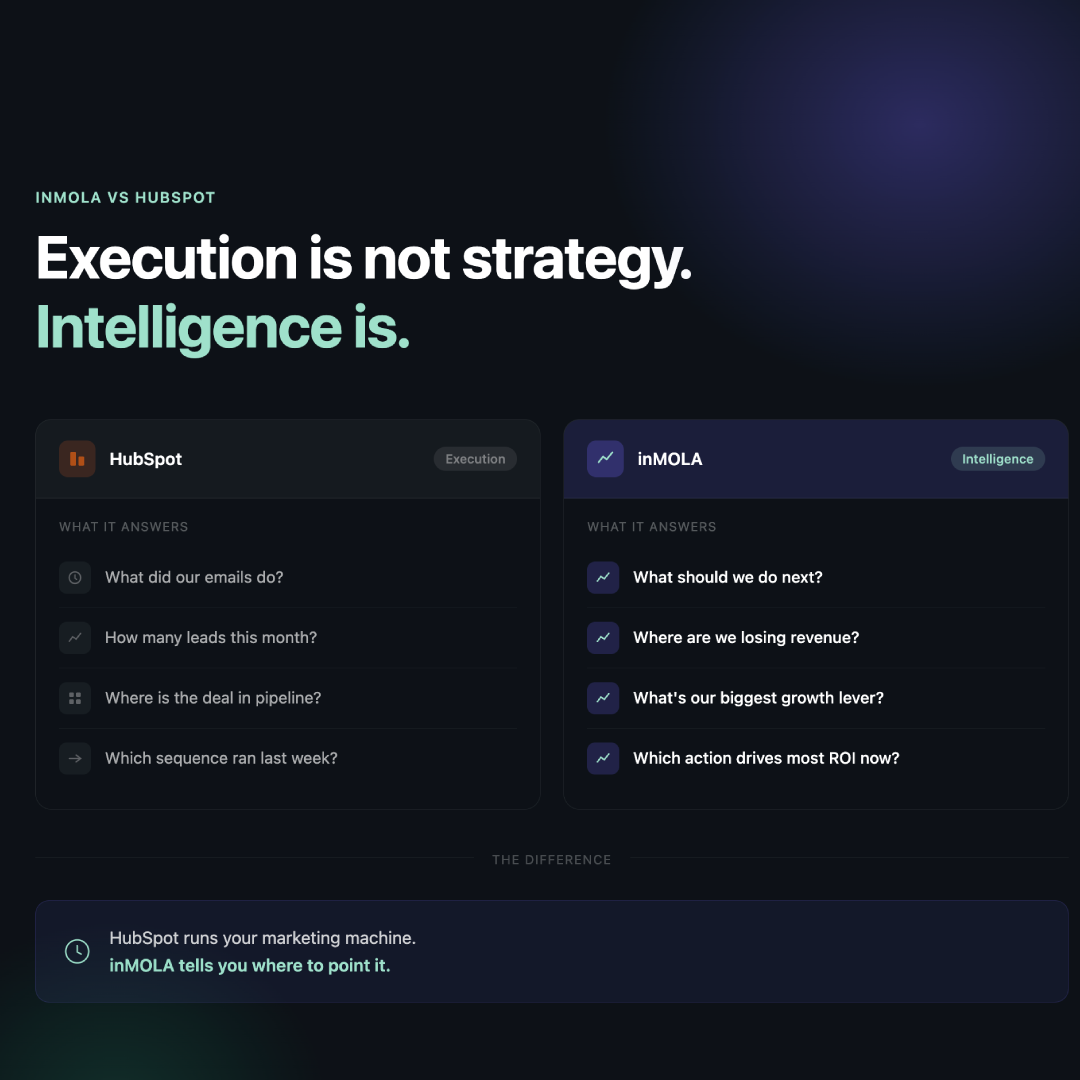
Let’s be honest about something most marketing software comparisons won’t tell you.
HubSpot is a great tool. It’s well-designed, widely adopted, and genuinely useful for managing contacts, automating workflows, and tracking pipeline activity. Millions of companies use it. Many of them use it well.
But there’s a question HubSpot — and tools like it — was never built to answer:
What should we actually do next?
Not what happened last month. Not which emails were opened. Not how many contacts are in which lifecycle stage.
What is the right strategic move for your marketing and sales operation, right now, given everything you know?
That’s a different question entirely. And it requires a different kind of tool.
__ __
What HubSpot Is Built For
HubSpot is, at its core, a CRM and marketing automation platform. It excels at:
- Managing and segmenting contact databases
- Automating email sequences and lead nurturing
- Tracking deals through a sales pipeline
- Running inbound marketing campaigns
- Reporting on campaign-level performance
These are operational capabilities. They help you execute marketing and sales activity — and execute it efficiently. For companies that need structure, process, and scale in their customer-facing operations, HubSpot delivers real value.
But execution is not strategy. And reporting is not intelligence.
__ __
The Gap No Dashboard Fills
Here’s what happens in most HubSpot-powered organizations.
The platform generates reports. Lots of them. Contact growth, email open rates, deal velocity, landing page conversions, traffic by source. The data is clean, the charts are polished, and the dashboards look impressive in a quarterly review.
And then someone asks: “So what does this mean for Q3?”
Silence.
Or worse — a meeting to discuss the reports, followed by another meeting to align on priorities, followed by a decision that’s based more on instinct than on the data sitting right there in the platform.
HubSpot tells you what happened. It does not tell you what it means, what’s causing it, or what you should do about it. That translation — from operational data to strategic decision — is entirely on you.
For companies with experienced, well-resourced marketing teams, that gap can be managed. But for the vast majority of marketing organizations — those working with lean teams, stretched budgets, and competing priorities — it’s where strategy quietly breaks down.
__ __
What inMOLA Is Built For
inMOLA starts where HubSpot stops.
It is not a CRM. It is not a marketing automation platform. It does not manage your contacts or automate your email sequences. Those are solved problems, and there are excellent tools — including HubSpot — that handle them well.
inMOLA is a marketing decision engine. It was built to answer the question that operational tools leave unanswered: what should you do next, and why?
Built on proprietary marketing algorithms developed over years of real-world practice across global brands, inMOLA unifies data across every marketing, digital, sales, brand, and communication channel. It doesn’t just aggregate — it evaluates. It scores performance against strategic objectives, identifies the relationships between data points that manual analysis misses, and surfaces clear, prioritized recommendations.
Not reports. Decisions.
__ __
A Different Kind of Intelligence
The distinction matters more than it might initially seem.
A report tells you your bounce rate increased by 12% last month. A decision engine tells you that the bounce rate increase is concentrated on mobile, correlates with a page load time regression introduced in your last site update, and is costing you an estimated 340 qualified sessions per week — and that fixing it should be your first priority before increasing paid spend.
A report tells you your email open rates are down. A decision engine tells you which segment is disengaging, what the likely cause is based on behavioral patterns, and what the three most effective interventions are given your current audience profile.
This is the difference between knowing your numbers and knowing your next move.
__ __
Do You Need Both?
Possibly. The answer depends on what problem you’re actually trying to solve.
If your primary challenge is operational — managing a growing contact database, scaling lead nurturing, structuring your sales pipeline — HubSpot is a strong choice. It’s purpose-built for those problems.
If your primary challenge is strategic — understanding what’s actually working, knowing where to invest, making faster and more confident decisions with the data you already have — that’s where inMOLA operates.
Many organizations need both layers: operational execution and strategic intelligence. They are not competing for the same job. HubSpot runs your marketing machine. inMOLA tells you where to point it.
__ __
The Real Cost of the Gap
Here’s the number that rarely appears in software comparisons.
The average company spending $4,000 or more per month on marketing tools is not getting proportional return — not because the tools are bad, but because the strategic layer is missing. The data exists. The execution capability exists. But the intelligence that connects them to business outcomes? That’s the gap.
Companies that close this gap — that add strategic decision intelligence on top of their operational stack — consistently outperform those that don’t. They move faster, waste less, and make better calls under pressure.
What international consulting firms have historically charged $100,000 or more to provide — the kind of strategic analysis and prioritized recommendations that actually move the needle — is now accessible, always on, and built directly into inMOLA.
__ __
HubSpot answers: What did our marketing do?
inMOLA answers: What should our marketing do next?
Both questions matter. But in a competitive market, the second one is the one that determines whether you win.
inMOLA is an AI-powered marketing decision intelligence platform built on proprietary algorithms by Erkan Terzi. It helps brands unify their marketing data, evaluate performance, and generate strategic intelligence for better business decisions. Learn more at inmola.com