16 Apr
Every year, the world’s largest companies spend hundreds of thousands — sometimes millions — of dollars on strategic marketing consultants.
Not on advertising. Not on tools. On thinking.
On the kind of structured, data-backed strategic analysis that tells an organization not just where it stands, but where it should go, what’s blocking it, and what to do first.
The companies that can afford this kind of counsel have a significant, measurable advantage over those that can’t. They make fewer expensive mistakes. They move faster in competitive markets. They allocate budgets with more precision and confidence.
For decades, this advantage has been reserved for the few.
That is changing.
__ __
What Consultants Actually Do
There’s a common misconception about what high-end marketing consultants deliver.
It’s not data. Their clients already have data — often more than they can process. It’s not reports. Reports are the commodity output of every analytics tool on the market.
What elite consultants deliver is synthesis and direction.
They take fragmented data from multiple sources, apply frameworks built from decades of cross-industry experience, identify the patterns that in-house teams are too close to see, and translate everything into a prioritized set of strategic recommendations.
The output is not a 200-slide deck. It’s clarity. A clear answer to: given everything we know about this business, its market, its competitors, and its customers — what should leadership focus on, and in what order?
That clarity has historically been worth a great deal of money. Because without it, even well-resourced marketing teams tend to optimize the wrong things, invest in the wrong channels, and measure the wrong outcomes.
__ __
The Three Things Consultants Know That Most Teams Don’t
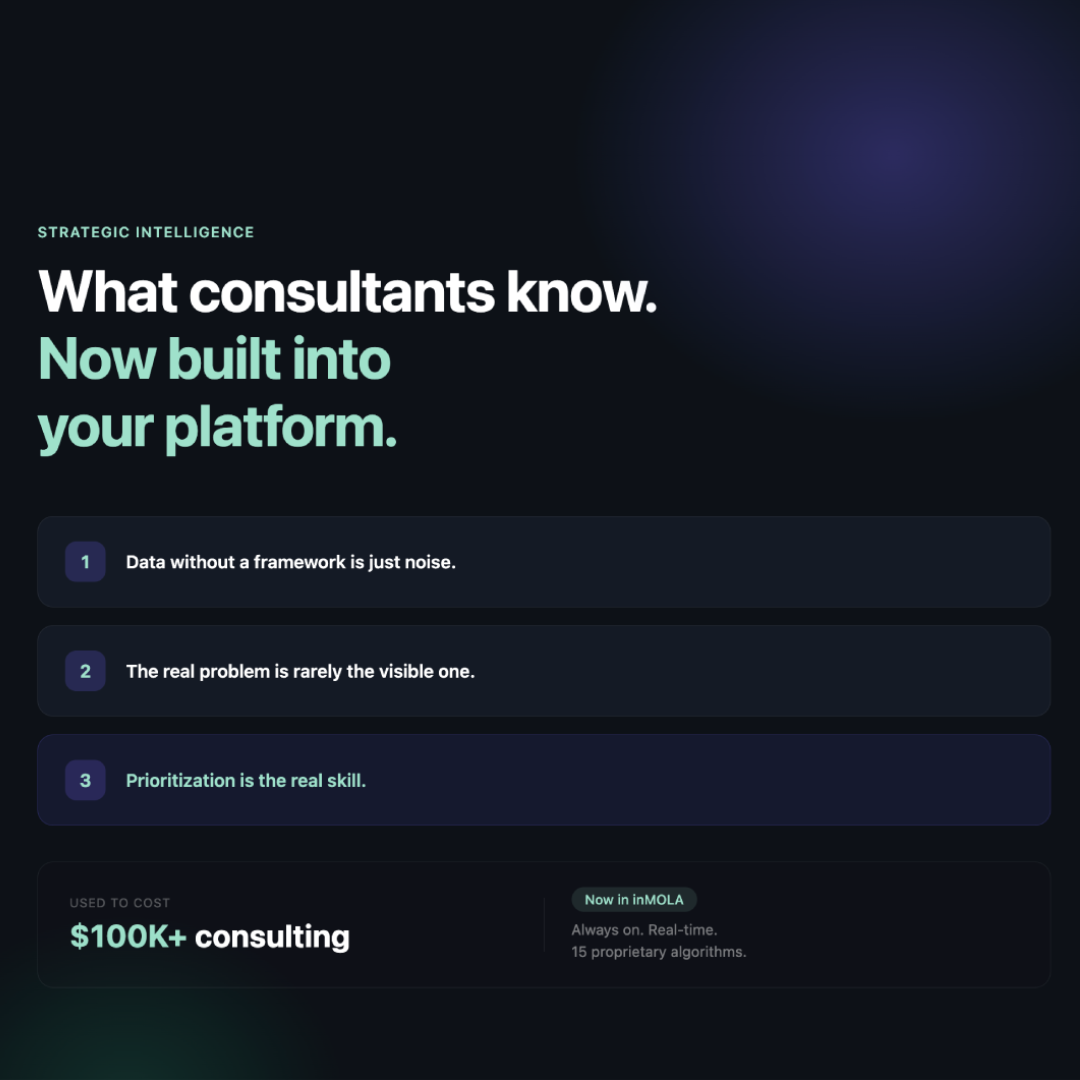
1. Data without a framework is just noise.
Most marketing teams are excellent at collecting data. They are less skilled at interpreting it within a coherent strategic framework — one that connects channel performance to brand health, brand health to competitive position, and competitive position to revenue outcomes.
Elite consultants don’t just look at your GA4 dashboard. They evaluate your data against a structured model of how marketing creates business value. That model — the framework — is what transforms raw numbers into strategic insight.
Without a framework, data points exist in isolation. A spike in bounce rate is just a number. Within a framework, it’s a signal connected to page experience, audience quality, messaging alignment, and conversion probability — all of which connect back to revenue.
2. The most important problems are rarely the most visible ones.
Marketing teams tend to focus on what’s measurable and immediate: this week’s campaign performance, this month’s lead numbers, this quarter’s conversion rate.
Consultants are trained to look for the underlying structural issues that drive surface-level symptoms. Poor conversion rates are rarely just a landing page problem. Declining brand awareness is rarely just a media spend problem. High customer acquisition costs are rarely just a targeting problem.
The visible problem is usually a symptom. The strategic problem is usually a level deeper. And solving the symptom without addressing the underlying cause is one of the most common — and most expensive — mistakes in marketing.
3. Prioritization is the real skill.
Every marketing team has more opportunities than resources. The question is never “what could we do?” It’s always “what should we do first, given our current position, our constraints, and our objectives?”
This is where most teams struggle — and where consultants add disproportionate value. Rigorous prioritization, backed by a clear-eyed assessment of the business situation, is what separates companies that grow deliberately from companies that stay busy without moving forward.
__ __
Why This Has Been Out of Reach
The value of strategic marketing intelligence has never been in question. The barrier has always been access.
Engaging a top-tier international consulting firm for a strategic marketing review requires a budget that most companies — even mid-sized ones — simply don’t have. Engagements routinely run from $50,000 to $100,000 or more. The process takes weeks or months. The output is a static document that reflects a moment in time.
For growth-stage companies, scale-ups, and even established mid-market businesses, this has meant operating without the strategic layer that their largest competitors take for granted.
The result is a persistent structural disadvantage. Companies make decisions based on instinct and partial information. They invest in the wrong priorities. They miss competitive threats until it’s expensive to respond. They grow — but not as fast, and not as deliberately, as they could.
__ __
The inMOLA Approach: Consulting-Grade Intelligence, Always On
inMOLA was built to close this gap.
The platform is built on proprietary marketing algorithms developed through years of real-world strategic work across global brands and industries — the same kind of frameworks that elite consultants use to synthesize data and generate strategic direction.
The difference is that inMOLA doesn’t deliver a one-time engagement. It operates continuously, unifying your marketing, digital, sales, brand, and communication data in real time, evaluating performance against strategic benchmarks, and generating prioritized recommendations that tell you not just what’s happening — but what to do about it.
The three things elite consultants know — the framework, the underlying problem, the prioritization — are built into the engine. Not as a static methodology, but as a live, adaptive system that works with your actual data, your actual market, and your actual competitive context.
What used to require a $100,000 consulting engagement is now accessible, scalable, and always current.
__ __
What This Means in Practice
For a marketing leader using inMOLA, the experience is fundamentally different from working with a traditional analytics platform.
Instead of opening a dashboard and interpreting numbers, you receive strategic direction. Instead of asking “what does this data mean?”, you’re already looking at the answer. Instead of scheduling a meeting to align on priorities, the priorities are already ranked — with the reasoning behind them.
The questions that used to require a consultant to answer:
- Where should we focus our marketing investment this quarter?
- Which of our current activities is generating the most strategic value — and which is generating noise?
- What is our most significant competitive vulnerability, and how do we address it?
- Are we building brand equity or eroding it?
These are now questions inMOLA answers continuously, in real time, for every company that uses it.
__ __
The Competitive Landscape Is Shifting
The gap between companies with access to strategic marketing intelligence and those without has always existed. What’s changing is the mechanism through which that intelligence is delivered.
The most forward-thinking marketing organizations are already operating with AI-driven decision intelligence embedded into their workflows. They’re not waiting for quarterly consultant reports. They’re making better decisions every week — informed by the same quality of strategic thinking that used to cost a hundred thousand dollars and take three months to produce.
The question for every marketing leader is not whether this kind of intelligence has value. That question has been answered by every company that’s ever paid for it.
The question is whether you’ll have access to it — or whether your competitors will.
__ __
The knowledge gap between enterprise marketing and everyone else has never been about data. It’s been about the frameworks, the synthesis, and the strategic direction that transforms data into decisions.
That gap is closing. And the companies that recognize it early — and act on it — will have a decisive advantage in the markets they compete in.
__ __
inMOLA is an AI-powered marketing decision intelligence platform built on proprietary algorithms by Erkan Terzi. It helps brands unify their marketing data, evaluate performance, and generate strategic intelligence for better business decisions. Learn more at inmola.com