11 Apr
There has never been more marketing data available. GA4 tracks every scroll. Your CRM logs every touchpoint. Ad platforms generate performance reports by the hour. Social tools measure reach, impressions, and engagement down to the minute.
And yet, ask a marketing director what they should do next — and most will pause.
Not because the data isn’t there. Because the insight isn’t.
—
The Data Paradox
Modern marketing teams are sitting on more information than any generation of marketers before them. But somewhere between the dashboard and the decision, something breaks down.
The problem isn’t volume. It’s translation.
Data tells you *what happened*. Insight tells you *what it means* and *what to do about it*. These are not the same thing — and confusing them is one of the most expensive mistakes a marketing organization can make.
Consider a typical week for a mid-size marketing team:
– GA4 shows a spike in bounce rate on the product page
– The CRM reports a dip in qualified leads
– The paid campaign dashboard shows CTR is up but conversions are down
– Social engagement increased but website traffic from social dropped
Each of these data points is real. Each of them is telling you something. But what? Are they connected? Which one deserves attention first? What action do you take?
Most teams do one of three things: they schedule a meeting, they add another dashboard, or they guess.
None of these is a strategy.
—
Why More Tools Haven’t Solved the Problem
The instinctive response to the data overload problem has been to buy more tools. Better analytics. Smarter dashboards. More integrations.
But here’s the uncomfortable truth: the average marketing team now uses between 15 and 30 tools. Each one generates its own data, its own reports, its own definition of success. The result isn’t clarity — it’s fragmentation.
You end up with data living in silos. Your SEO data doesn’t talk to your CRM. Your ad performance doesn’t connect to your brand tracking. Your content metrics exist in isolation from your revenue data.
Each tool optimizes for its own output. None of them synthesize across the whole picture. And none of them tell you what your business should actually do on Monday morning.
This is the gap that costs companies millions — not in tool subscriptions, but in wrong decisions, missed opportunities, and strategies built on incomplete pictures.
—
The Human Cost of Data Overload
Beyond the strategic cost, there’s a human one.
Marketing teams today spend a disproportionate amount of their time collecting, cleaning, and reporting data — rather than acting on it. Studies suggest that data professionals spend up to 80% of their time preparing data and only 20% actually analyzing it.
That ratio is backwards. And it’s burning out some of the most talented people in the industry.
When marketers spend their days building reports instead of building strategy, something else happens: decision-making gets slower. By the time the data is clean, compiled, and presented, the market has moved. The campaign window has passed. The competitor has already acted.
Speed of insight is now a competitive advantage. And most organizations are losing it.
—
What Intelligence Actually Looks Like
There’s a reason that the world’s largest companies — the ones with the biggest budgets — have historically paid international consulting firms hundreds of thousands of dollars for strategic marketing intelligence.
Not for more data. For the synthesis, the framework, and the actionable direction that transforms raw numbers into confident decisions.
That synthesis is what’s been missing for everyone else.
Real marketing intelligence doesn’t just measure what happened. It evaluates performance across every channel simultaneously, identifies the relationships between data points, scores them against strategic objectives, and surfaces the actions most likely to drive growth.
It answers the questions that dashboards never do:
– Which of our marketing activities is actually contributing to revenue — and which is just generating noise?
– Where are we losing customers, and at which stage?
– What should we prioritize this quarter given our current brand position and competitive landscape?
– Are we growing, or just busy?
These are not data questions. They are intelligence questions. And they require a fundamentally different approach.
—
The inMOLA Approach: From Data to Decision
This is exactly the problem inMOLA was built to solve.
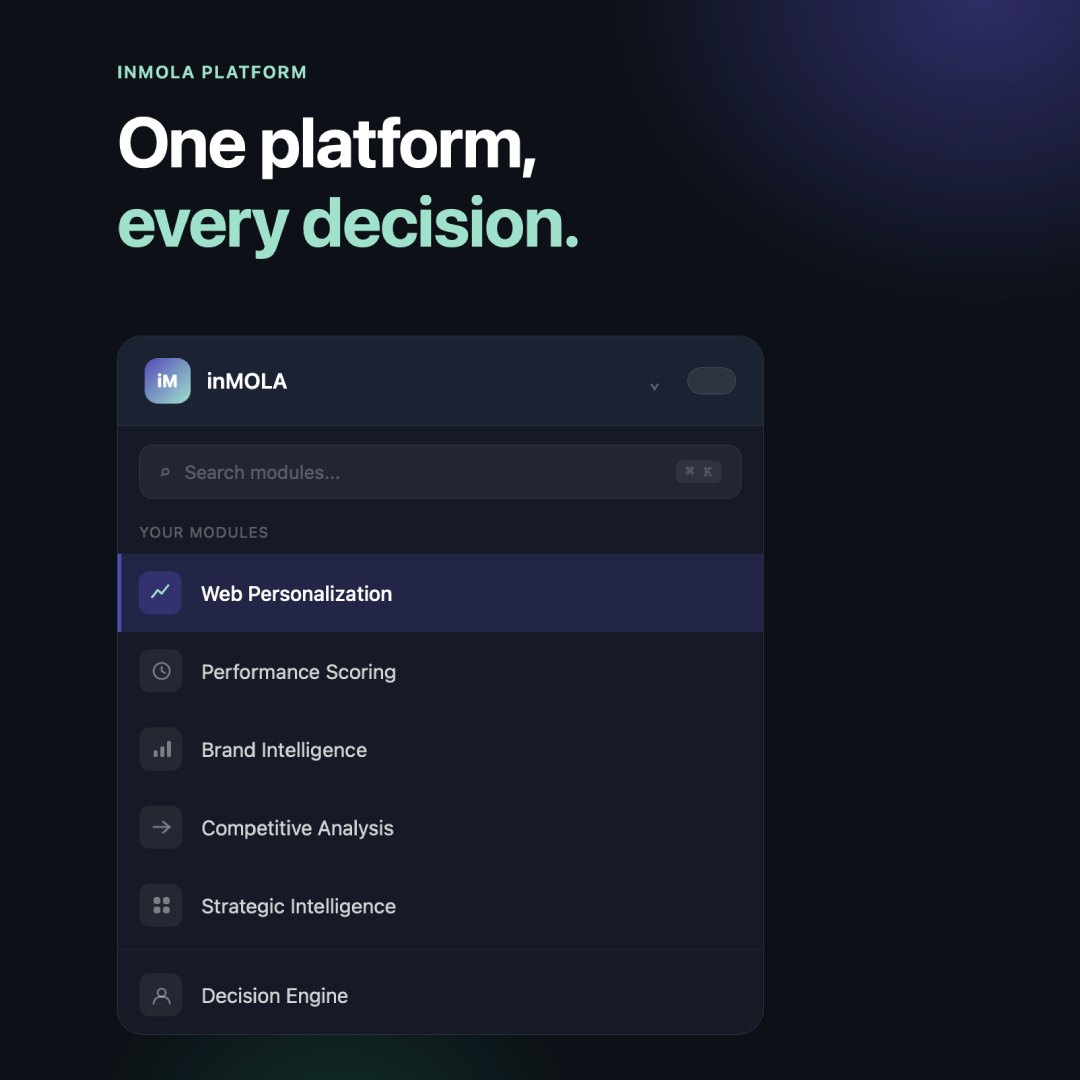
inMOLA is an AI-powered marketing decision engine built on proprietary marketing algorithms developed over years of real-world practice across global brands and industries. It doesn’t add another silo to your stack. It unifies your existing data — across marketing, digital, sales, brand, and communication — and transforms it into strategic intelligence.
The platform generates performance scores across all active channels, surfaces the relationships between data points that manual analysis misses, and delivers clear, prioritized recommendations. Not reports. Decisions.
What international consulting firms have traditionally delivered with budgets of $100,000 or more — the kind of strategic analysis that tells you not just where you are, but where to go and how to get there — is now accessible, scalable, and always on.
For marketing teams drowning in data, inMOLA is the difference between knowing your numbers and knowing your next move.
—
The Shift That’s Already Happening
The most forward-thinking marketing organizations are already making this shift — from data collection to decision intelligence. They’re investing less in adding tools and more in synthesizing what they already have. They’re measuring success not by the volume of reports produced, but by the quality and speed of decisions made.
The competitive advantage in marketing is no longer who has the most data. It’s who can turn data into action — faster, more accurately, and more consistently than anyone else.
The question for every marketing leader is simple: are you managing data, or are you making decisions?
—
Data without intelligence is just noise. And in a world where every competitor has access to the same platforms, the same channels, and increasingly the same data — the only real differentiator is what you do with it.
The teams that win won’t be the ones with the biggest dashboards. They’ll be the ones who figured out how to stop drowning and start deciding.
—
*inMOLA is an AI-powered marketing decision intelligence platform built on proprietary algorithms by Erkan Terzi. It helps brands unify their marketing data, evaluate performance, and generate strategic intelligence for better business decisions. Learn more at inmola.com*