Customer Intelligence & Retention
Real-Time Web Personalization · 12 июля 2026 г. · 8 мин чтения
The 40% bounce on paid traffic is usually diagnosed as 'bad traffic quality.' It is more often bad message continuity — the ad promised one thing, the homepage delivered another, and the visitor left inside three seconds.
Every performance team has argued with the media buying team about the same number. The paid traffic bounce rate is 40%, and someone in the room concludes the audience targeting must be wrong, or the ad platform is sending bots, or the campaign creative is attracting the wrong clicks. The next quarter is spent narrowing the audience, tightening the placements, and adjusting the creative — and the bounce rate barely moves.
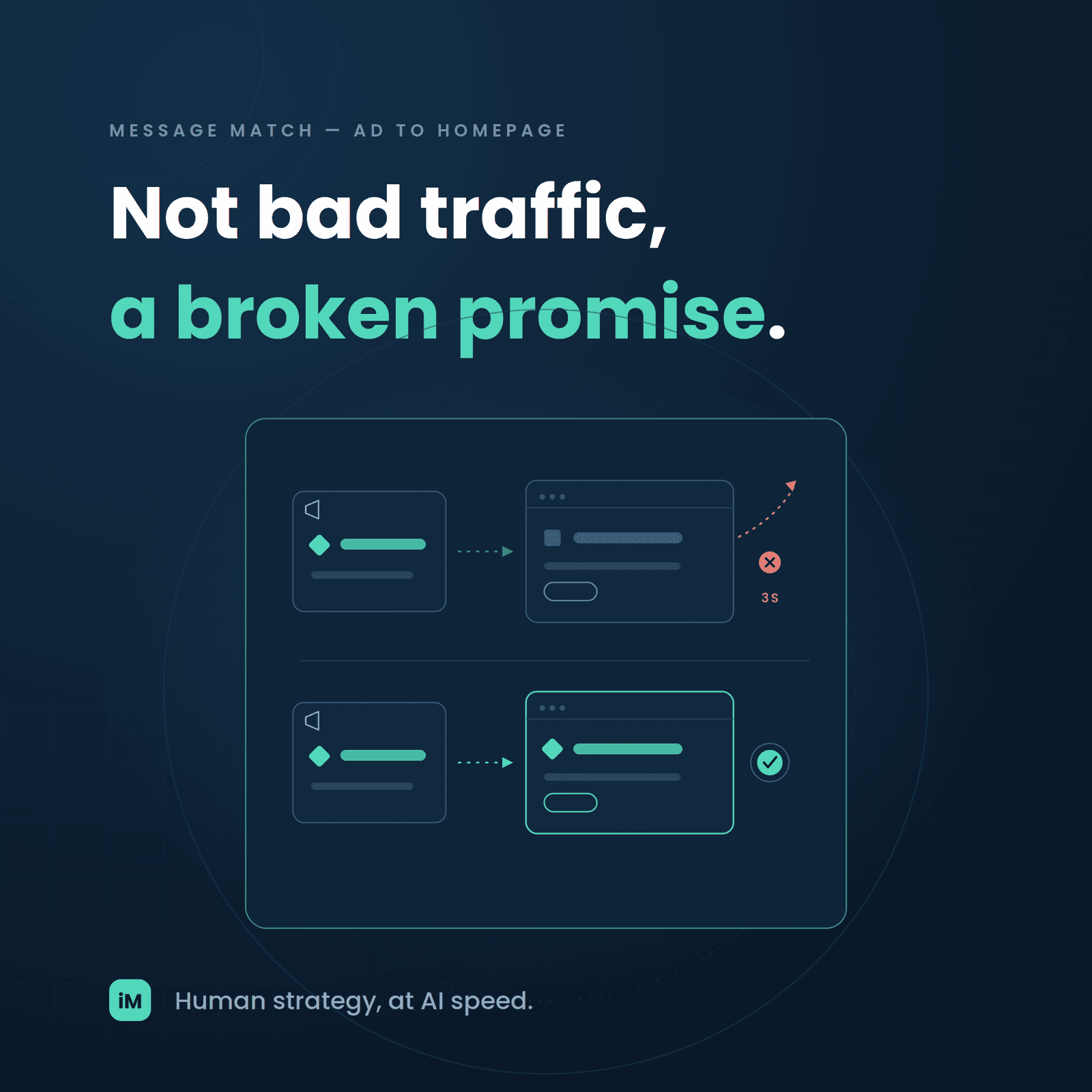
The reason it barely moves is that the diagnosis was wrong. The 40% bounce is rarely bad traffic. It is more often bad continuity — the ad promised a specific product, a specific offer, or a specific message, and the homepage the click landed on delivered a general introduction to the brand that made no reference to the ad the visitor had just clicked. The visitor's three-second attention budget expires while the page tries to explain everything, and the visitor concludes the ad was misleading and leaves.
This piece walks through what message-match actually means, why it breaks in enterprise setups even when the marketing team knows it matters, and the specific rules that close the gap between the ad and the landing experience.
Message-match is the continuity between what a visitor was told they would find and what the page they landed on actually shows them in the first two to three seconds. It applies most obviously to paid ads — the ad said 'winter boots on sale, up to 40% off' and the landing page should mention winter boots and the 40% offer inside the first viewport — but it applies to organic search results, email links, referral partners, and every other channel where the visitor arrived with a specific expectation.
The technical definition is simple: the landing experience should confirm within the first three seconds that the visitor is in the right place. The confirmation does not have to be verbatim — it can be a hero image, a headline, a subheadline, a badge, or a CTA — but it has to be visible without scrolling, without a load delay, and without requiring the visitor to reason their way to the connection.
The counterexample is the generic homepage as landing page. The ad said 'winter boots.' The homepage says 'welcome to the store, browse our collections, sign up for our newsletter.' The visitor spent three seconds looking for the boots, did not see them, and bounced. The click cost real money, the ad platform reported the click as delivered, and the outcome was zero.
The enterprise version of message-match usually breaks for structural reasons, not because the marketing team does not know about it. The most common structural failure is that the ad and the landing page are owned by different teams. The paid team writes the ad; the web team owns the homepage; and the request 'please build a landing page for this specific campaign' hits the engineering backlog behind six other priorities and does not ship in time for the campaign.
The workaround the paid team usually falls back on is to point the ad at the closest existing page rather than a matched landing page. The winter boots ad points at the boots category page rather than a boots-and-40%-off landing page. The specific offer is lost. The message-match is partial. The bounce rate is not what it could have been, and the campaign report attributes the underperformance to 'audience quality' rather than to the missing landing page.
The second structural failure is that even when landing pages exist, they proliferate uncontrollably. Each campaign gets its own landing URL, the URLs sprawl across the site, maintenance falls behind, and the paid team ends up pointing at an old landing page that references a campaign that ended six weeks ago. The message-match technically exists but confirms the wrong message, which is arguably worse than confirming nothing.
Rule-based personalization on the homepage inverts the pattern. Instead of building a landing page per campaign, the homepage adapts to the campaign the visitor arrived from. The rule 'visitors from the winter-boots-40% campaign, show the winter boots hero with the 40% badge' is set up in minutes, lives in a panel not a codebase, and is retired when the campaign ends without leaving a stale URL behind.
The message-match rule set that produces the largest lift in most enterprise programs is a small one — three to five rules that cover the majority of paid spend.
These five rules typically cover 70-80% of paid traffic in a typical enterprise campaign portfolio. The remaining 20-30% is edge cases — obscure campaigns, low-volume placements, one-off partnerships — that do not warrant a dedicated rule but can share a fallback rule that at least confirms 'campaign-driven visitor, matched category.'
The unlock that makes rule-based message-match practical is treating UTM parameters as active inputs to the personalization engine, not just as passive analytics tags. Most enterprise programs use UTMs for reporting attribution and nothing else — the UTM tells GA4 which campaign drove the visit, and that is where its role ends.
Reflex-style personalization reads the UTM at page load, matches it to the rule library, and swaps the content accordingly. The UTM becomes the connective tissue between the ad and the landing experience. This requires UTM discipline — consistent naming, controlled vocabulary, campaign IDs that mean the same thing across ad platforms — but the discipline pays off in both attribution accuracy and personalization leverage.
The compound advantage is that the same UTM discipline that improves multi-touch attribution also improves message-match. The marketing operation invests in the discipline once and benefits twice.
The measurable outcome of tight message-match on paid traffic is a bounce rate that drops from the 40-55% range to the 25-35% range on the matched segments. The lift shows up first in the campaigns with the tightest ad-to-hero coupling — the specific-product ads, the specific-offer promotions, the retargeting campaigns targeting known cart abandoners — and expands as more rules land.
The revenue implication is not just fewer bounces. Every visitor who stays past the three-second mismatch decision is a visitor with active intent that the funnel now has a chance to convert. The downstream metrics — session depth, add-to-cart rate, checkout completion — all lift, and the paid ROAS calculation reflects it. The same ad spend produces materially more conversions when the landing experience finally matches what the ad promised.
The finance conversation also changes. The paid team can defend the ad budget with cleaner logic: the ad is delivering the click at the target cost, and the landing experience is now confirming the click. The bounce rate is no longer a shared point of blame between paid and web teams — it is a design variable that both teams can influence with their own tools.
The 40% bounce on paid traffic is usually diagnosed as bad targeting. It is more often bad continuity. Fix the continuity, and the same audience produces materially more conversions.
Closing the message-match gap does not require a landing-page factory or an engineering sprint. It requires reading the UTM at page load, matching to a rule, and swapping the hero content according to the rule. Three to five rules covering the top campaigns land the majority of the addressable lift in the first month.
inMOLA's Reflex module reads the referring source and campaign parameters the moment the visitor lands, matches to the rule library, and swaps the hero, banner, or call-to-action to confirm the message the visitor arrived expecting. Rules are built in minutes, go live on the next visit, and measure impressions, clicks, and conversions in the same view where they were authored. The message-match gap that used to require a landing page per campaign now runs as a rule set on the homepage.
The paid traffic bounce rate that the media buying team has been defending for years is not fixed. It is a specific consequence of the ad and the landing page being disconnected, and the connection is a rule away.
Customer Intelligence & Retention
Customer Intelligence & Retention
Customer Intelligence & Retention