Customer Intelligence & Retention
Real-Time Web Personalization · 11 июля 2026 г. · 9 мин чтения
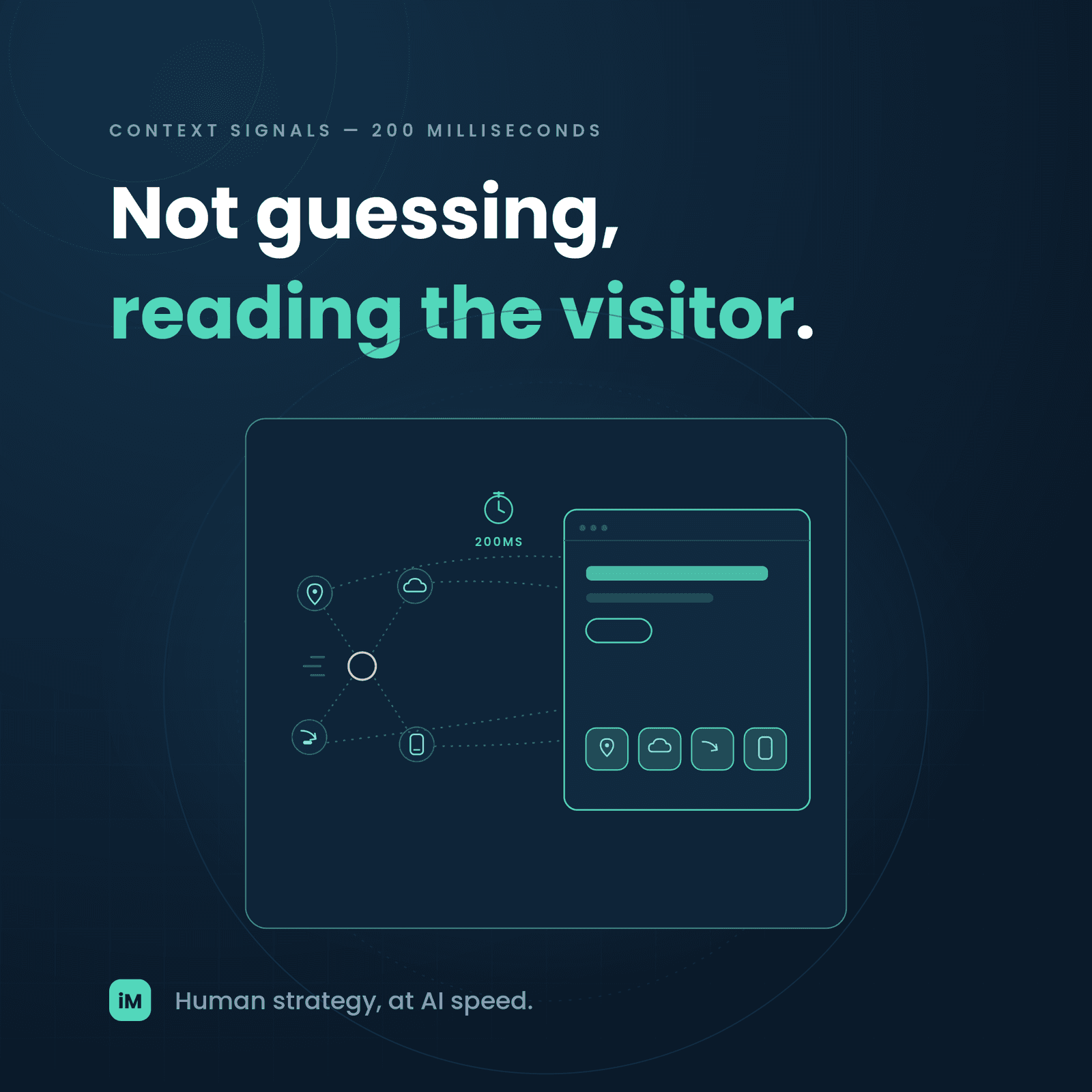
Every visitor arrives carrying a context the homepage could read in the first 200 milliseconds. Four signals — location, weather, source, and device — cover the majority of buying-intent variance, and almost every enterprise homepage ignores all four.
Every visitor who lands on a website arrives carrying a context. Where they physically are. What the weather is doing above them. What device they are holding. Where they came from and, if they came from paid media, which specific campaign message was fresh in their head three seconds ago. This context exists whether the site reads it or not. The question is whether the marketing team is designing against it or ignoring it.
The default in 2026 is still to ignore it. The homepage is one page for all visitors, the signals are used at most for analytics reporting after the fact, and the buyer's context is treated as noise rather than as an input. The cost of that default is not a mystery — it shows up as bounce rate on the wrong segments, as message-mismatch on paid traffic, and as regional or weather-driven windows that pass without a matched offer.
This piece walks through the four context signals that carry the most buying-intent variance, why each one matters, how they compose in practice, and what specifically breaks when the homepage does not read them.
The first and most under-used context signal is the visitor's physical location. Country and city are easy to read from IP with acceptable accuracy for personalization purposes; the goal is not surveillance-grade precision but a good-enough signal to swap a hero, a currency, a shipping expectation, or a seasonal reference. Weather is a downstream signal from location — knowing it is raining in Istanbul right now is what turns 'visitor from Istanbul' into 'visitor who might actually want the rainwear campaign.'
The buying-intent implications of location cover more than the obvious cases. A visitor from a country outside the primary market sees pricing in a currency that requires mental conversion, shipping windows measured in weeks not days, and a hero image featuring a season that is opposite theirs. The visitor does not always articulate the mismatch — they just leave, and the aggregate bounce rate absorbs the event without exposing the cause.
Weather is the most valuable location-derived signal because it has short-horizon buying-intent leverage. Categories where weather matters — outdoor apparel, home comfort, delivery services, travel, food, gardening, event bookings — see meaningful demand swings tied to what the sky is doing in the visitor's specific city on the specific day. A homepage that carries a static seasonal message misses every one of those windows. A homepage that reads the local weather can lift the exact offer that matches the day's conditions.
The specific mechanic worth spelling out is that weather-driven demand is asymmetric — the visitor who arrives on a rainy day is much more likely to convert on a rain-relevant product than the visitor who arrives on a clear day. A generic hero splits the difference and captures neither. A rain-aware rule captures the first, and the clear-day rule captures the second.
The second context signal is how the visitor arrived. A visitor from a Google search for a specific product is not the same as a visitor from a Meta ad about a specific campaign, is not the same as a visitor from a direct URL, is not the same as a visitor from an email link. Each source produces a different mental state, and the homepage that treats them all as equivalent is squandering the leverage each source provides.
The most valuable version of this signal is paid-ad continuity — the visitor who clicks an ad about product X arrives with product X actively in their head, and the homepage has three seconds to confirm that it remembers what the ad was about. If the hero mentions everything except product X, the visitor concludes the ad was misleading and bounces. The technical name for this is message-match, and it is the single largest source of avoidable bounce on paid traffic.
The organic-search version of the signal is subtler but equally leverageable. A visitor searching for a specific brand comparison, a specific product category, or a specific problem arrives with a specific frame. The homepage that speaks to that frame — 'you were comparing X and Y — here is what our position is' — converts at a materially higher rate than the homepage that requires the visitor to re-navigate to the section that answers their actual question.
Direct visitors carry the least contextual signal from the source itself, but the referrer-less visit is often correlated with prior familiarity — a returning customer, a saved bookmark, an in-person recommendation. Treating them as first-time visitors and forcing them through the introduction sequence they have already seen is a specific friction the source signal makes visible.
The third context signal is what the visitor has done on the site before. Which pages they visited, which products they viewed, which category they abandoned. This is the highest-value personalization signal in most enterprise programs because it captures intent that has already been demonstrated on the site itself, not inferred from external context.
The specific pattern is the abandoned-mid-journey shopper. A visitor who browsed washing machines and left is a different visitor from one who has never touched large appliances, and the homepage that greets both identically is treating a hot lead like a cold one. The rule 'visitors who browsed large appliances and left, show the large-appliance campaign on the homepage on their next visit' is the canonical Reflex example because it addresses the segment with the highest known intent using the signal the site already has.
The compound value of the prior-history signal is that it stacks with the other three. A returning shopper who browsed washers, on a rainy day, from a specific paid campaign, on mobile, receives a hero that combines all four signals — and the specificity of that hero produces conversion rates that a generic homepage will never approach.
The fourth signal is device. Not just mobile-versus-desktop as a layout decision — most sites handle that at the CSS level — but device as a context signal that shapes which offer to lead with, which format to serve, and how much friction the visitor will tolerate.
A mobile visitor is often in a different intent mode than the same visitor on desktop. Mobile visits skew toward shorter sessions, faster decisions, less patience for form fills, and higher weight on trust signals that can be read at a glance. A hero designed for the desktop's exploratory frame will underperform on the mobile visitor's decision frame even when the layout renders correctly.
Device × source interaction is where the signal earns its keep. A mobile visitor from a Meta ad about a specific product needs a single-focus hero with a large tap-target and a message that matches the ad in five words or less. A desktop visitor from an organic search comparing brands needs a broader hero that acknowledges the comparison frame and offers content that answers it. The two visitors are looking at the same page and need materially different homepages.
The signals are not additive — they interact. A rule that reads all four signals produces a specific combination that a rule reading one signal cannot approach. The combinatorial explosion sounds intimidating, but in practice most enterprise programs land on twelve to twenty rules that cover the majority of the traffic composition.
The pattern that emerges is a small number of high-value combinations doing most of the work. The paid-ad-clicker on mobile in the primary market is one. The returning abandoned shopper on desktop in an underserved region is another. The organic searcher from a weather-affected city on a category-relevant day is a third. Each combination is worth a specific rule, and the rules stack into a homepage that actually reads the context each visitor arrives with.
The operational discipline that makes this work is measuring per-rule performance in the same view where the rule is built. A rule that sounded clever in the planning conversation but produces no lift in production gets retired. A rule that produced modest lift in month one but doubled in month three gets protected. The rule set becomes an evolving asset the marketing team owns, not a one-time integration project.
The specific failures that follow from ignoring the four signals are all recoverable — they show up as bounce rate, as message-mismatch, as regional revenue that never materialized, as weather-relevant windows that closed before an offer was matched to them. None of them are catastrophic in isolation. All of them are compounding when they run unaddressed across a quarter.
The cost is easiest to see when the segmented reporting is set up. A bounce rate of 55% aggregated is easy to accept. The same bounce rate breaking down as 30% on the matched segments and 78% on the mismatched segments is much harder to accept, because the 78% is a specific set of visitors the site is systematically failing.
Every visitor arrives carrying a context the homepage could read in the first 200 milliseconds. The programs that read it will spend the next four quarters compounding a conversion advantage over the ones that do not.
Reading the four signals does not require a data warehouse project or a new CDP. It requires a lightweight snippet on the site that reads the context, a rules panel the marketing team owns, and a measurement view that closes the loop between rule and outcome. The first-month goal is not comprehensive coverage — it is landing three to five rules that address the largest bounce-composition gaps and watching them measure.
inMOLA's Reflex module reads all four signals — location and weather, source and campaign, device, and prior browsing history — and lets the marketing team build rules that combine them without engineering support. Rules go live on the next visit. Impressions, clicks, and conversions live in the same view where the rule was authored, so the four-day iteration loop replaces the four-week engineering cycle.
The four signals are not new information. Every visitor has been carrying them for years. The programs that finally read them will look back on the one-size homepage the way marketing teams already look back on batch-and-blast email — as an obvious compromise that persisted because the tooling was not yet ready to move past it.
Customer Intelligence & Retention
Customer Intelligence & Retention
Customer Intelligence & Retention