Customer Intelligence & Retention
Customer Intelligence & Retention · 16 июля 2026 г. · 9 мин чтения
Every customer in the base is one of four archetypes — Loyalist, Casual, Slipping, Departed. Each one needs a different intervention, and the generic 'customer marketing' program that treats them the same delivers the wrong action to three of them.
Every marketing team knows intuitively that a first-time buyer is not the same as a repeat customer, and a lapsing customer is not the same as one who has already left. The intuition is correct, but almost every marketing program still operates as though it were not — the same email, the same offer, the same loyalty tier logic firing across the whole customer base with only cosmetic segmentation between them.
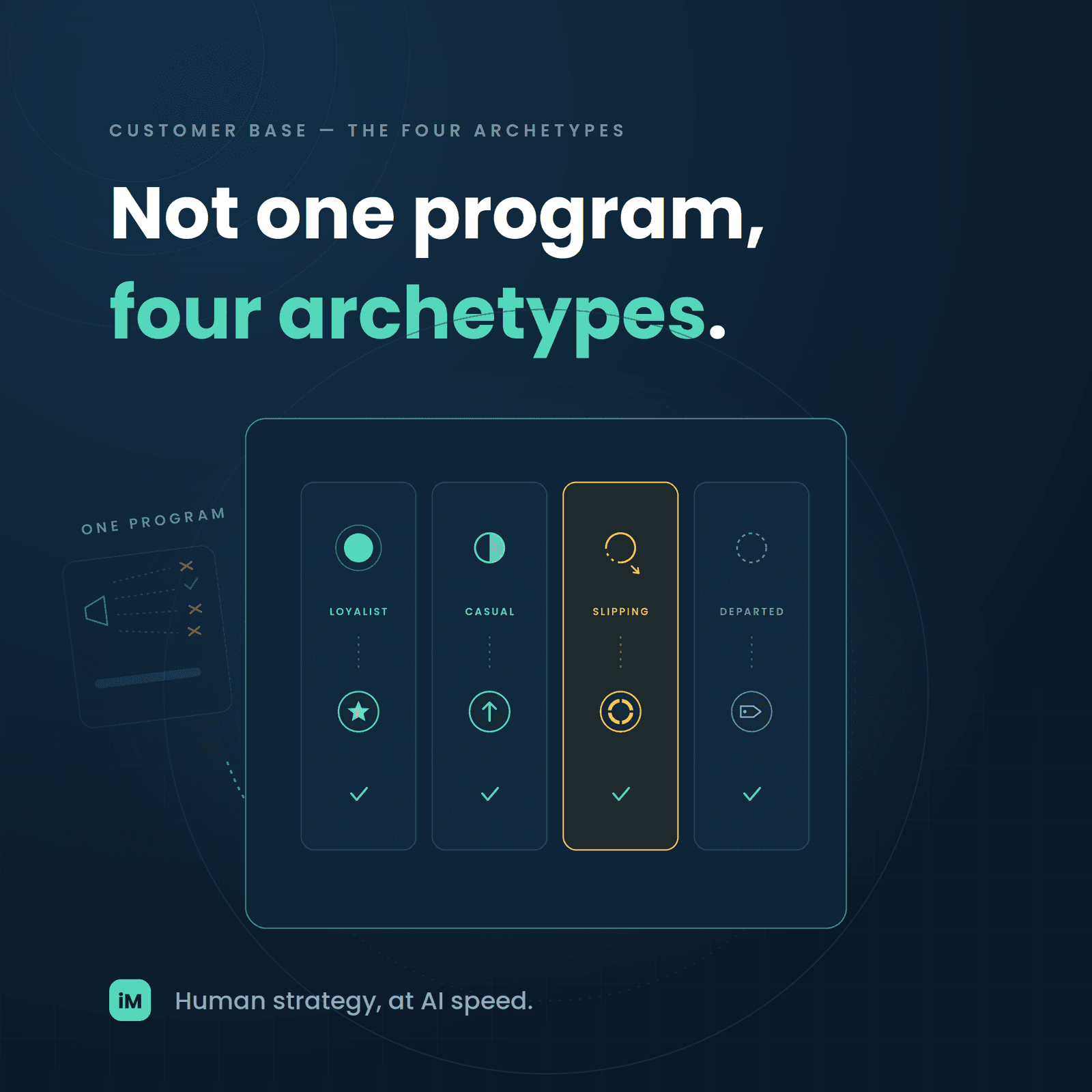
The correction is not more segmentation for its own sake. It is a specific four-archetype framework that captures the four distinct states every customer moves through, and a matched intervention for each state. Loyalist, Casual, Slipping, Departed. The archetypes are behavioral, not demographic. They apply to any business with repeat customers, and the interventions for each are meaningfully different from the others.
This piece walks through each archetype in detail — what the state looks like operationally, what intervention it needs, what intervention it does not need, and what specifically breaks when the four are treated as one.
The Loyalist is the customer whose purchase frequency, basket size, and retention are all high, and whose behavior signals continued engagement with the brand. In most consumer businesses, Loyalists represent 15-25% of the base and produce 50-70% of the revenue. They are the archetype the entire marketing operation is fundamentally defending, whether it realizes it or not.
What the Loyalist needs is protection, not activation. The intervention is confirmation that the relationship is being valued — early access to new products, meaningful recognition in the loyalty program, a level of service that acknowledges the customer's value to the business. The intervention is not another discount code, another welcome campaign, or another 'have you seen our new arrivals' email that treats the Loyalist as though they were a Casual who needed to be reintroduced to the brand.
The specific failure mode with Loyalists is over-marketing. A Loyalist who receives the same generic promotional cadence as the rest of the base concludes that the loyalty is not being seen. The relationship degrades not from any single event but from a compounded sense that the brand does not know them. The Loyalist slowly reclassifies as a Casual, then as Slipping, and the marketing operation never notices until the segmented revenue view exposes the drift.
The Casual customer purchases occasionally but not with the frequency or basket of a Loyalist. They are the largest single population in most consumer bases — often 40-55% of the customer count — and they represent the largest addressable growth opportunity because moving even a fraction of them into the Loyalist tier produces disproportionate revenue lift.
What the Casual needs is activation — reasons to purchase more frequently, reasons to increase basket size, reasons to engage with the brand between purchases. The intervention is targeted content that matches the Casual's demonstrated interests, offers that reward incremental engagement, and reminders that fire at natural buying moments rather than on generic promotional calendars.
The specific failure mode with Casuals is the aspirational-tier promise. A loyalty program that promises 'unlock premium status at 12 purchases per year' addressed to a Casual who currently purchases 4 times a year is offering a reward the Casual will not reach, and the effect is the opposite of activation — the Casual concludes the program is not for them and disengages further. The intervention has to be calibrated to the Casual's actual behavior, not to the tier the marketing team wishes they would reach.
The Slipping customer is one whose behavior has degraded — purchase frequency has dropped, basket size has narrowed, engagement signals have weakened — but who has not yet left. The Slipping archetype is the highest-leverage segment for retention marketing because the customer is still in the base, still receiving communications, and still recoverable if the intervention is well-timed.
What the Slipping customer needs is diagnosis and recovery — an intervention specific to what caused the slip. If the slip is price-driven, a targeted offer that acknowledges the value gap. If the slip is service-driven, a specific service recovery that addresses the trigger. If the slip is drift-driven — the customer simply losing habitual engagement — a re-engagement campaign that reminds them of the relationship's value.
The specific failure mode with Slipping customers is undifferentiated win-back. The default response — a discount code with 'we miss you' — treats every slipping customer as though the same intervention will recover them. It works on a small fraction and burns the margin on the rest. The archetype-based response reads the specific slip signature and matches an intervention that addresses it.
The Departed customer has left. The last purchase is far enough back and the engagement signals have decayed enough that the relationship is over in operational terms, whether the customer explicitly said so or not. The Departed archetype is the smallest population in most bases in any given quarter but the highest cumulative population over time, because every quarter's Slipping customers who did not recover become the next quarter's Departed.
What the Departed customer needs is honesty about the state of the relationship. In most cases, the intervention is to stop marketing to them — the send stops, the retention spend is reallocated, and the segment is recognized as loss rather than pursued as opportunity. A small subset of Departed customers can be reactivated through a specific offer or a genuine product change, but the reactivation rate is materially lower than the Slipping recovery rate, and treating the Departed segment as a recovery target dilutes the effort on the segments where recovery is actually possible.
The specific failure mode with the Departed is over-investment. A retention program that keeps sending discount codes to customers who have been Departed for six months is spending against a segment that will not respond. The spend feels productive because the emails still send and the reports still run, but the CAC on the customers who do respond becomes indefensible when the true recovery rate is measured.
The four archetypes are not fixed labels. Every customer moves through the states over time — starting as a new Casual, activating to Loyalist, occasionally slipping under specific conditions, and eventually departing. The health of the customer base is a function of the flows between the states, not the snapshot of any single state.
The migration view is what makes the four-archetype framework operationally useful. The marketing team is no longer defending an aggregate retention rate — they are managing five specific flows, each with its own leading and trailing indicators.
The first change is that the loyalty program becomes tier-appropriate. Loyalists get the recognition that keeps them Loyalist. Casuals get activation offers calibrated to their current behavior. Slipping customers get diagnostic interventions rather than generic discounts. Departed customers stop absorbing spend. The program pays out where it produces measurable outcomes.
The second change is that retention marketing stops being a single campaign and becomes an archetype-matched rule set. The 'we miss you' email is retired; in its place is a set of rules that fire different content to different Slipping signatures, and the aggregate recovery rate lifts because each Slipping subtype gets the intervention that actually addresses its cause.
The third change is the finance conversation. Instead of defending a flat retention rate, the marketing team can decompose the number into the specific flows — activation rate, degradation rate, recovery rate, churn rate — each with an intervention and an outcome. The retention line becomes a managed system rather than a single number that either moves or does not.
Every customer is in one of four states. The generic 'customer marketing' program that treats them the same is delivering the wrong intervention to three of them.
Adopting the four-archetype framework does not require a platform migration. It requires defining the archetypes for the specific business, scoring every customer into one archetype at any given time, and matching the retention rule set to the archetype each customer occupies. The first-month goal is the Slipping recovery rule — the highest-leverage single intervention — and a clean measurement of its recovery rate against the pre-rule baseline.
inMOLA's Customer Score module classifies every customer into the four archetypes automatically, tracks the migration flows between them, and exposes each customer's current state alongside the specific intervention the state warrants. The retention program becomes an archetype-matched rule set that fires the right message to the right customer at the right moment.
The four-archetype framework is not new theory — it has been in the retention marketing literature for two decades. The change in 2026 is that the individual-level scoring finally makes it operationally practical. The marketing programs that adopt it first will spend the next four quarters compounding retention gains over the programs still running one campaign for everyone.
Customer Intelligence & Retention
Customer Intelligence & Retention
Customer Intelligence & Retention