Customer Intelligence & Retention
Ad Performance & Attribution · 8 juillet 2026 · 8 min de lecture
When ad performance drops, the default reflex is to blame the creative. Sometimes that is correct. Often it is not. A four-signal diagnostic framework separates creative fatigue from targeting decay from channel compression from delivery drift.
Every performance marketer has been in the meeting where a campaign is underperforming and the room instinctively agrees that 'the creative needs refresh.' Sometimes that instinct is right. Sometimes it is expensive — a creative rebuild costs weeks of production time, and if the real issue was targeting or channel compression, the rebuild fixes nothing and the underperformance continues after launch.
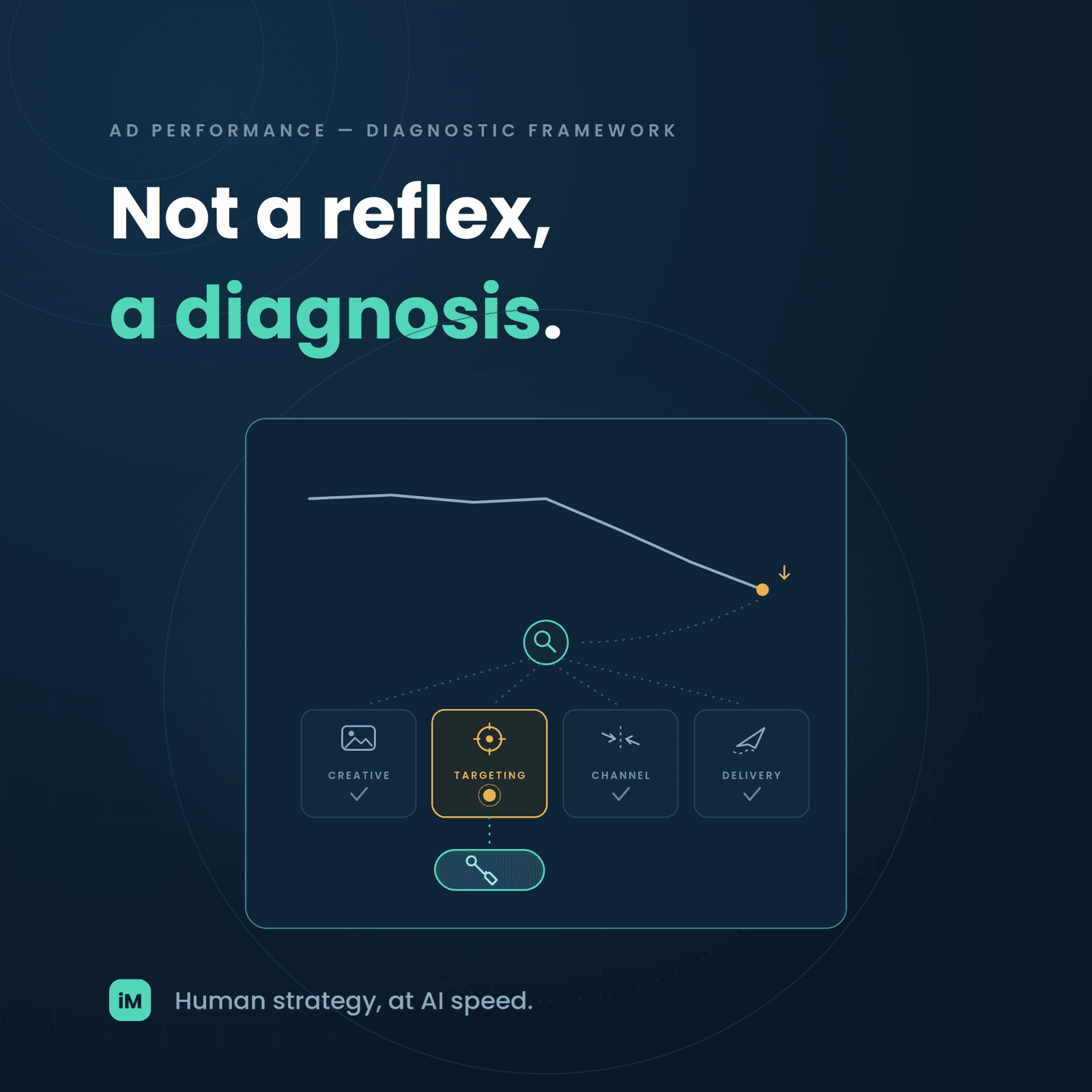
The reason the wrong diagnosis is common is that the surface signal — 'ROAS is falling' or 'CTR is compressing' — does not distinguish between four very different underlying causes. Creative fatigue, targeting decay, channel-wide compression, and algorithmic delivery drift all produce similar-looking performance dips. Different causes require different responses, and the response is worth more than the raw effort of running one.
This piece lays out a four-quadrant diagnostic framework that separates the causes. The framework uses signals a marketer can read from standard campaign data plus the cross-channel scoring that the modern ad monitoring stack produces.
The first diagnostic question is whether the underperformance is isolated to one channel or shows up across channels. If the same creative is running on Meta and TikTok, and it is underperforming on Meta while performing normally on TikTok, the problem is almost certainly not the creative. Something specific to Meta — auction pressure, algorithm change, audience saturation on the Meta side — is the cause.
The action that follows is not creative rebuild. It is a Meta-specific diagnosis: check the audience overlap with recent campaigns, check the CPM against category benchmarks, check whether a competitor has entered the audience segment. The creative is fine; the environment around it changed.
The inverse test is equally useful. If the same creative is underperforming across all channels simultaneously, the diagnosis points harder at creative fatigue or content-market misfit. But the confirmation still requires ruling out the possibility that the audience or the offer changed — a category-wide demand shift can also produce simultaneous multi-channel decline.
The second question is what the pattern looks like across creative variants on the same channel. If Meta is underperforming and only one creative on Meta is dying while three other creatives on Meta are fine, the diagnosis is creative fatigue on the specific asset. Rotate it out, refresh the queue, keep the channel.
If all creatives on Meta are dying simultaneously, the diagnosis is not creative. Creative fatigue is asset-specific — different assets fatigue on different cadences depending on their impression accumulation. Simultaneous decay across every asset in the account almost always points to audience fatigue, not creative fatigue. The audience has been over-hit and stops responding regardless of what asset is served to it.
The action for audience fatigue is not creative rebuild. It is audience expansion, exclusion of the fatigued segment, or a lookalike refresh. Rebuilding creative into a fatigued audience buys a week of relief before the same pattern reasserts itself.
The third question is what the CTR/ROAS relationship looks like. A campaign with a healthy CTR but weak ROAS is not underperforming for creative reasons — the creative is doing its job of earning clicks. The click is landing somewhere that is not converting.
This is a targeting or offer problem. The audience is engaged enough to click, but the click is misaligned with the audience's actual intent, the landing page is not converting the traffic, or the offer is not competitive against the alternatives available to the click. Rebuilding creative here is expensive and irrelevant; the intervention is on targeting or on the post-click experience.
The mirror signal is a campaign with weak CTR and healthy ROAS on the clicks that convert. This is a filtering problem — the creative is only earning clicks from qualified buyers, but it is not reaching enough of them. The intervention is on reach (audience expansion, different creative that attracts a broader qualified click) rather than on conversion.
The fourth question is how a new creative launch is performing. A newly launched creative that starts strong and decays over 10-14 days is normal fatigue and does not warrant special diagnosis. A newly launched creative that decays inside the first 48-72 hours signals an algorithmic delivery problem, not a creative problem.
The specific mechanic is that platform delivery algorithms rapidly reoptimize toward whichever audience segment the initial impressions engage with best. If the initial engagement is on a low-quality segment (bots, incidental traffic, disengaged demographics), the algorithm doubles down on that segment and the CTR/ROAS collapses inside days.
The intervention is not creative rebuild. It is either restarting the campaign with tighter initial audience constraints, or moving the creative to a manual-bidding structure that does not let the algorithm chase the wrong segment. The creative is often perfectly fine on the intended audience.
Combining the four diagnostic principles produces a compact framework that maps observed signals to likely causes and appropriate actions.
The framework is not exhaustive. It does not cover every possible cause — auction volatility, seasonal shifts, competitor entry, and platform algorithm updates all produce edge cases. But it covers the four causes that account for the majority of underperformance events, and it prevents the default reflex of blaming creative when the actual cause is somewhere else.
The reason a diagnostic framework is worth the effort is that misdiagnosis compounds. Rebuilding creative when the actual cause is audience fatigue produces a two-week delay while the new creative is produced, then a one-week honeymoon on the new asset, then the same fatigue pattern reasserts itself because the audience is still fatigued. The team then rebuilds again, and the cycle repeats.
Meanwhile the real intervention — audience expansion or exclusion — was a one-day project that would have restored performance immediately. The lost weeks and the wasted creative production cost are the cost of misdiagnosis, not the cost of the creative rebuild itself.
The same logic applies to every cause the framework covers. Rebuilding creative when the channel has changed does nothing. Rebuilding creative when targeting is the problem does nothing. Rebuilding creative when delivery drift is the problem does nothing. Four out of the four common causes require interventions that are not creative rebuild.
AI creative suggestions are useful for the cases where creative genuinely is the problem — content-market misfit, single-asset fatigue with no queue behind it, or a campaign where the concept has run its course. In those cases the suggestion layer accelerates the rebuild by producing directionally correct starting points, saving days of concept work.
The suggestion layer is not a substitute for diagnosis. It is a tool for the diagnosed case where creative is confirmed as the intervention. Using it as a default response to every performance dip is the same misdiagnosis pattern the framework is designed to prevent, dressed up in AI clothing.
The most expensive creative rebuild is the one that fixes nothing because the actual problem was audience, targeting, or delivery. The framework's value is in preventing the rebuild that should not happen.
Adopting the diagnostic framework does not require new tooling. It requires the marketing team to pause for 15 minutes before every performance-dip response and answer the four questions: is the pattern channel-isolated, is it creative-isolated, what is the CTR/ROAS relationship, and how long has the affected creative been running. The answer to the four questions points at the intervention that will actually work.
inMOLA's Advertisement module runs the diagnostic pattern continuously — surfacing which underperformance is creative-driven versus channel-driven versus targeting-driven, and providing AI creative suggestions only for the cases where creative is confirmed as the intervention. The reflex to blame creative gets replaced by the discipline of matching the intervention to the actual cause.
Customer Intelligence & Retention
Customer Intelligence & Retention
Customer Intelligence & Retention