Customer Intelligence & Retention
Ad Performance & Attribution · 5 juillet 2026 · 8 min de lecture
Most ad waste happens in a 24-hour window that monthly review will never catch. Statistical anomaly detection on CPC, CTR, cost, and ROAS closes the window before the damage is priced in.
Ask any senior performance marketer where the biggest ad spend leak in their program is, and they will not describe a strategic error. They will describe a moment — a Thursday afternoon when the CPC on their best-performing campaign silently doubled, and no one noticed until the following Tuesday's report. By then the damage was already priced into the quarter. The question is not whether these moments happen; it is whether the monitoring cadence is fast enough to catch them.
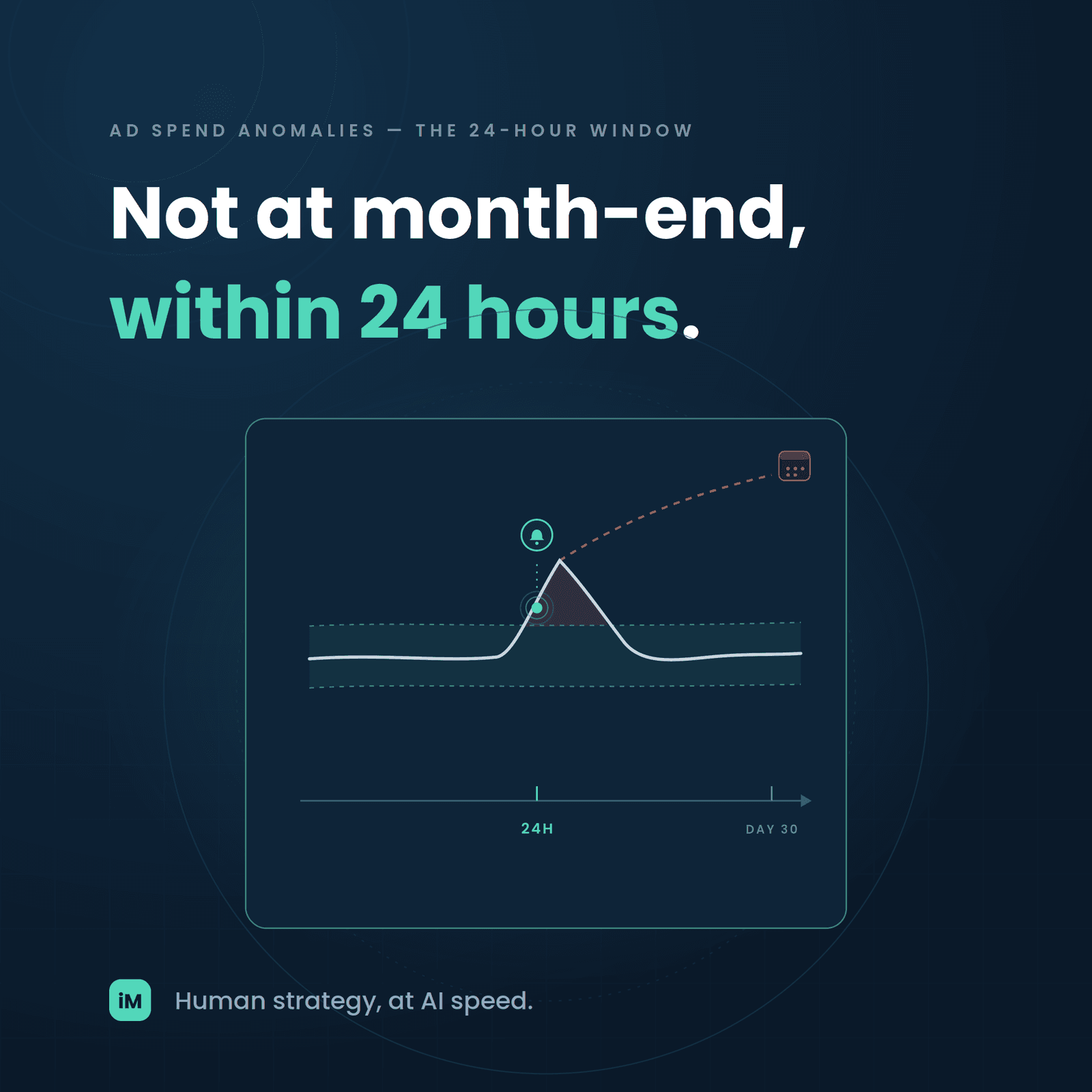
The uncomfortable truth is that monthly and even weekly reporting cannot catch these events at all. A CPC spike that runs for 48 hours can burn a full week of the campaign's budget with zero incremental value. By the time the pattern shows up in a weekly rollup, the money is spent and the CPC has often already normalized, leaving a mysterious 'expensive week' on the report with no obvious cause.
This piece walks through the anatomy of a 24-hour ad waste event, why traditional review cadences systematically miss it, and how statistical anomaly detection closes the window inside the same day the event begins.
The mental model of a CPC spike as 'the auction got more competitive' is directionally correct but operationally useless. The specific mechanics vary, and each mechanism has a different response.
The first mechanic is auction volatility. Ad platforms run continuous auctions, and the price you pay is a function of who else is bidding, what their budgets are, and what their creative quality is. A competitor launching a large campaign in your keyword or interest set can push CPCs 40-60% higher within hours. This is exogenous to your account — nothing you did caused it — but you are paying for it in real time.
The second mechanic is algorithmic drift. Platform delivery algorithms continuously reoptimize toward whichever audience segments are converting best. If the algorithm shifts toward a more expensive segment (higher intent but higher competition), your CPC rises even though your targeting has not changed. This is the platform's optimization decision, not yours.
The third mechanic is creative fatigue. As a creative accumulates impressions against the same audience, its relevance signal degrades. The platform interprets the degrading engagement as lower ad quality, which pushes the effective CPC up as a compensation. Fatigue is gradual, but it accelerates non-linearly near the end — a creative that has been fine for three weeks can spike hard in 48 hours.
The fourth mechanic is competitor entry into a category. If a new brand enters your competitive set with an aggressive launch budget, your CPCs across every channel that carries your buyer's attention will rise simultaneously. The signal shows up in your account before the competitive intelligence tools flag the entry.
The mathematics of monthly and weekly review cadence guarantee that in-day spikes are invisible. A CPC that doubles for 36 hours and then returns to baseline will show up in a weekly average as a modest lift — perhaps 8-12% depending on the underlying spend distribution. That number is easily dismissed as 'noise' in the review meeting, and the review moves on.
The problem is that the 36-hour spike burned real money. A campaign spending $2,000 a day at a normal $1.20 CPC captures roughly 1,600 clicks per day. The same campaign spending $2,000 a day at a spiked $2.40 CPC captures 833 clicks — nearly half the traffic for the same spend. Across 36 hours, that is 1,150 lost clicks. If the conversion rate is 4% and the average order value is $75, the missed revenue is $3,450. That is the cost of not seeing the spike inside the day it happened.
Weekly review cannot close this gap because the signal is buried in the average. Only daily or intra-day review can, and only if the review has a statistical basis for calling a specific number 'unusual' rather than relying on a human eye to notice.
Statistical anomaly detection sounds like a data science project, but the underlying idea is simple. You take the metric you care about — CPC, CTR, cost, ROAS — and compare today's number to the recent baseline. If today's number is more than two standard deviations from the baseline, it is statistically unlikely to be noise, and the system flags it.
The specific measurement is the z-score: the difference between today's number and the baseline mean, divided by the baseline standard deviation. A z-score of 2 means today is at the edge of the normal range. A z-score of 3 means today is definitively unusual. The z-score is a threshold-crossing signal — the moment the metric crosses, the alert fires, without waiting for a scheduled review.
The advantage over a fixed-percentage threshold ('alert me if CPC rises 30%') is that z-score adjusts to the natural volatility of the metric. A channel with steady CPCs will alert on a 25% rise; a channel with naturally noisy CPCs will not alert until the rise is 60%. The alert threshold self-calibrates.
The output is not just an alert. It carries two attributes: severity (high, medium, or low based on z-score magnitude) and direction (rise or fall). A high-severity CPC rise fires louder than a medium-severity CPC drift. A ROAS fall is treated as urgent; a ROAS rise is treated as informational. The alert triage is built into the signal.
Not every metric warrants continuous anomaly detection. The four that carry the highest cost-of-delay are the ones worth monitoring.
The four signals are ordered by cost-of-delay. CPC and ROAS are the immediate money leaks. CTR is the earlier warning that predicts them. Cost creep is the accumulation signal that budget owners need before the review meeting rather than during it.
An anomaly alert is not a fix. It is an entry point into a response playbook. The playbook has three tiers, matched to the severity of the anomaly and the confidence of the diagnosis.
Tier one is the fast pause. If the anomaly is a high-severity CPC surge on a campaign that is clearly deteriorating, pause the campaign for four hours while the diagnosis runs. A four-hour pause typically costs less than a 24-hour spike.
Tier two is the targeted refresh. If the anomaly is a CTR crash with normal CPC, the diagnosis usually points to creative fatigue. Rotate to the next creative in the queue, watch the CTR recover, and log the fatigue timing for the next campaign's rotation cadence.
Tier three is the strategic response. If the anomaly is category-wide — all channels showing CPC pressure simultaneously — the diagnosis is often a competitor entry or category demand shift. The response is not campaign-level; it is a media plan revisit.
The other operational piece that makes continuous anomaly detection work is the resolved-flag layer. When a marketer receives an alert, diagnoses it, and takes action, they mark the anomaly resolved. That resolution is a data point — it links the anomaly type to the action that resolved it. Over time, the resolved history becomes a playbook that the whole team can consult.
The compound benefit is that anomaly detection stops being an interruption and becomes a learning system. The first time you see a CPC surge on your best Google campaign, you diagnose it manually and take an hour to resolve. The tenth time you see the same pattern, the resolution is a two-minute action informed by the eight past resolutions.
Weekly review is a maintenance rhythm. Continuous anomaly detection is a defense system. They are not substitutes; they run at different timescales, and the one that saves the quarter is the fast one.
The gap between when an ad waste event begins and when the marketing team notices it is the specific variable that separates efficient programs from wasteful ones. In 2020 the gap was measured in weeks. In 2023 it was measured in days. In 2026 the leading programs are running the gap down to hours, and they are doing it with statistical anomaly detection on the four fast-fail metrics.
inMOLA's Advertisement module runs continuous z-score anomaly detection on CPC, CTR, cost, and ROAS across every connected channel — surfacing severity, direction, and the resolved-history context, so the response happens inside the same day the anomaly begins. The 24-hour ad waste window closes.
Customer Intelligence & Retention

Customer Intelligence & Retention
Customer Intelligence & Retention